






Your shopping cart is currently empty.
Cisco-Eagle: Service and Commitment
Customer focused and employee owned
A reliable partner for over 50 years
Cisco-Eagle was born in 1970 when Warren Gandall, a material handling specialist for an industrial supply company, went into business for himself.
Mr. Gandall had a vision of creating a chain of material handling distribution companies in the Southwest. In partnership with one of the company's first vendors, Eagle Material Handling was born.
There were only three employees in the beginning, and just a few vendor partners. The first month, they took eight orders - slightly over $8,000 in sales. But the company thrived and grew. Within the next couple of years, Eagle expanded to an office in Oklahoma City and a sales representative in Little Rock, Arkansas.
In the beginning, there was no forklift. Trucks were unloaded by hand. Warren installed a lot of rack and shelving. He said with a laugh "that was enough to last me the rest of my life." One particular installation stuck in his mind. At 6:30 p.m., New Year’s Eve, 1970, a truckload of rack showed up. The shipment was late, so in order to get the material installed to the customer’s satisfaction, they had to unload the truck by hand, reload the material on their own truck, and take it out for installation on New Year’s Day. It took six hours to unload that truck.
A gamble that paid off
1974 was a breakthrough year for Eagle. In June of 1974, a group of employees bought Eagle from its original parent company. At this point, Warren invited his lifelong friend Bill Cupps to join the company. According to Warren, he told Bill "I know you like to gamble…have I got a gamble for you!" The gamble worked, and the company grew. In 1975 Eagle Material Handling opened its Little Rock office.
Eagle grew by leaps and bounds. Along with all that growth, came change. "Change is unavoidable," Warren said. "You change or you stagnate." In the beginning, Eagle sold material handling equipment, but also sold industrial lift trucks. In 1978, Eagle decided to stop selling lift trucks and focus on the "allied lines" that lift truck houses considered secondary to their business - equipment like racks, shelving, and other warehouse storage equipment.
Looking to the future
In 1981, conveyor was quickly becoming the company’s focus - and remains so to this day. Mr. Gandall believed that in order to sell conveyor properly, one had to have systems & design capabilities as well as a top conveyor manufacturer like Hytrol Conveyors.
Enter Victor Leonard. He was Eagle's first Systems and Design employee, and eventual vice president of engineering. Eagle’s first large integrated system was a $1 million distribution center for convenience store chain QuikTrip. Like most companies at the time, Eagle didn’t have CAD machines, or any personal computers. This didn't matter, even if it seems primitive by today's standards.
Mr. Leonard was not only the engineer on the project, he was also the draftsman. There were 8-10 subsystems on this project. Every drawing produced was done by hand. There were probably 25 revisions to each drawing. Today, Cisco-Eagle executes a constant stream of projects larger than that first large system, utilizing a well-equipped team of project managers, engineers and design personnel. Adapting to the demands of customers was always the idea.
In 1985, Eagle Material Handling formed a holding company and purchased Dallas-based Cisco Material Handling. Cisco had been in business since 1959, doing largely the same kind of projects Eagle Material Handling had done. They started with a rotary dial telephone system and five outside salesmen. There were no computers, no inside sales support, no systems support. At this point, the company had stocking warehouses in Tulsa, Oklahoma City, and Dallas. The Little Rock office was acquired in 1988.
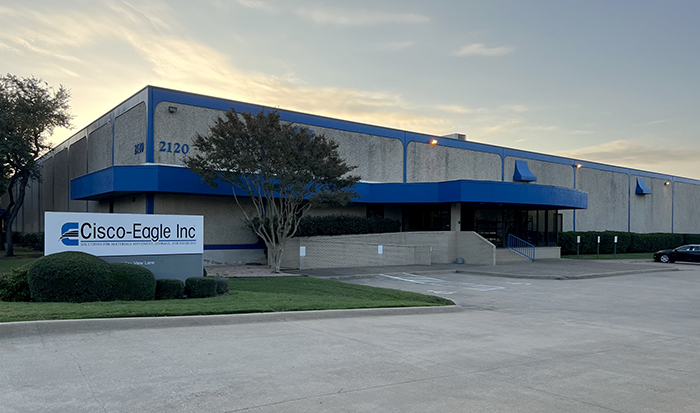
In 1995, Eagle Material Handling and Cisco Material Handling merged to become Cisco-Eagle, Inc. Today, Cisco-Eagle's Dallas headquarters is pure state-of-the-art in both technology and personnel.
Cisco-Eagle now has offices across the country, ranging from Alabama to Wisconsin with national and international customers due to extensive partnership agreements and our ability to engineer, sell and implement almost anywhere.
Systems Technology Group
In 2024, Cisco-Eagle acquired Trinity Controls, an innovative controls engineering company located in Birmingham, Alabama. The merger resulted in the Cisco-Eagle Systems Technology Group, which develops, programs and fabricates high-performance PLC controls and HMI systems that allow our clients to stay ahead in a rapidly changing automation landscape.
Exceptional service by Employee-Owners
In April of 2000, Cisco-Eagle made the transition to an employee-owned company. As of 2020, Cisco-Eagle's employees own 100% of the company. We consider each other business partners and operate in ways that increase our collective long-term value. That means we strive for exceptional service for our customers and partners.
With a firm culture of ownership, creativity and empowerment, the company is poised for a bright future, with innovative partners, empowered to do work at their best.
From a handful of outside salesmen to a company with scores of vendor partners, thousands of customers and a reputation in the industry as an innovator, Cisco-Eagle has challenged itself and serviced its customers for over 50 years.