








Your shopping cart is currently empty.
Pallet Flow ROI: a Deep Dive
An engineer's guide to volume, density, throughput and ROI
Ask our Experts!
From an engineering standpoint, pallet flow systems are more of a throughput optimization system than a pallet storage strategy. But most discourse we see focuses only on pallet density.
When pallet flow fits, it fits great and delivers on all the marketing hype that surrounds it. But if your operation doesn't have the right combination of volume, repetition, and depth, it may not be the right solution. This guide walks through the specific numeric thresholds and operational triggers based on all the decision points that determine when pallet flow is justified.
What problem does pallet flow solve?
Many pallet flow pallet rack discussions start with how it works. Gravity rollers, lane depth, FIFO—those details are easy to find. They're only specifications. The next focus is on density. And when you're trying to solve a storage density problem, that's great. But that's not the only problem pallet flow solves, and not the only problem pallet flow can solve.Finding the differences is the start of the process
With selective rack, every pallet you need requires one-to-one operator travel. As throughput increases, that travel and the interactions at the start/end of it are your dominant cost drivers.
- You're chasing SKUs one at a time with one forklift for every pick and every placement.
- Congestion builds in active aisles. This can send drivers constantly through the rack aisles, to shipping, to staging and back all day. They'll get in each other's way. Safety becomes a concern.
- If FIFO (first-in, first-out) is required, the problem compounds. Now, pallets must be repositioned or re-handled to maintain rotation. It may become more convenient for drivers to pick the older inventory first if it's positioned closer to them.
- You have to track and place fresh inventory so that the older stuff is used first. It's all manual, even with good WMS. People must know where the older pallets are, and then must pick them in preference to newer ones.
- This is why you typically don't see selective rack used for FIFO needs. Pushback and drive-in enforce LIFO dynamics, so they don't work at all for FIFO needs.
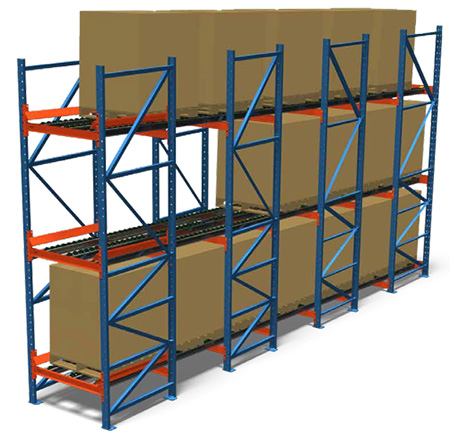
Pallet flow changes the dynamic by separating loading and picking into independent perpendicular aisles. When a pallet gets picked from the front, the next up rolls into place. This consolidates all those forklifts moving from points A, to B to C or even D to pallets rolling forward a few feet. The result is not just higher density; it's more predictable, faster and continuous flow.
The variables that should drive your decision-making process
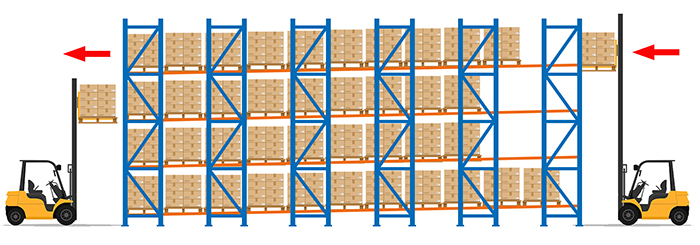
Above: Typical pallet flow applications require depth. How many pallets of the same SKU do you carry?
1) Depth: the how many pallets per SKU are you warehousing?
Depth of storage is probably your most important factor, and the start of most pallet flow spec projects. It drives whether you have the strategic need for a pallet flow system.
Most warehouses fall into these SKU concentration ranges:| Storage type | Typical pallets per SKU | Operational fit |
|---|---|---|
| Selective Rack | 1-3 | High SKU count, low depth, maximum access |
| Push-Back Rack | 2-6 | Moderate depth, reduced aisles, LIFO storage |
| Drive-In Rack | 6-12+ | High density, low selectivity, forklift enters rack structure |
| Pallet Flow | 6-20+ | High-volume SKUs, deep lanes, FIFO environments. Good single-SKU selectivity |
Because operations are messy, these ranges overlap. Gray areas are common. But in practice, the transition point is clearer than it looks. Once you consistently exceed six pallets per SKU, the economics shift. By the time you reach eight or more, pallet flow lanes can usually be filled efficiently and kept that way. Below that line, you risk consistently empty lanes and the economics tend to make less sense.
However: At times, people deploy pallet flow simply to maintain fresher inventory rotation even though they lack the pallet-per-SKU ratio needed. They may also want the storage density.
Read more: Selectivity vs. Storage Density: Choosing the Right Pallet Rack for Your Application
2) Volume concentration: how do you distribute inventory?
Once we've defined inventory, the next factor is its distribution across SKUs. Pallet flow requires depth continuity, not just total volume.
Pallet flow performs best when volume is concentrated into a relatively small number of products. It sings when each SKU justifies a full, active dedicated lane. In contrast, operations with high SKU counts and shallow inventory don't fully leverage pallet flow systems. Even if total pallet volume is high, SKUs might be spread too thin, which leads to inefficient, partially filled lanes. This is the classic "honeycombing" problem, and pallet flow does not tolerate it well. You can still deploy pallet flow in these situations, but your ROI isn't as strong.
3) Pallet throughput factors: how often do your pallets move?
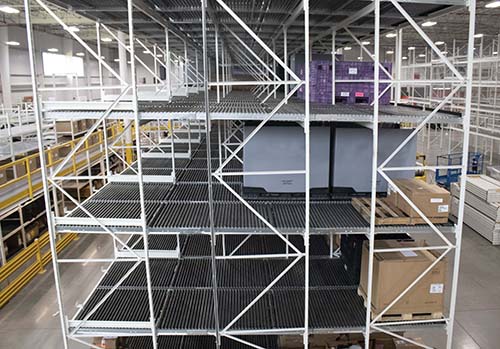
Throughput is where pallet flow creates much of its value, but throughput isn't celebrated like storage density is. In low-activity environments, the difference between storage systems is less pronounced. But when movement frequency increases, the cost of travel, touches and handling grows. If you're moving only a few single-SKU pallets a day, a wall of them in selective racks isn't a problem. You won't see the types of congestion and labor inefficiency you see at higher volumes.
A useful way to think about it is in bands:
- When you have fewer than (roughly) 5 pallet moves per SKU per day, movement is too low to justify flow systems (at least for throughput reasons).
- At 5-15 moves/day, system choice starts to matter. You have more options and more choices.
- Above 15-25 moves a day, flow-based systems separate clearly from your other options.
At higher throughput levels, pallet flow reduces both travel time and handling variability. Operators are no longer retrieving from deep storage positions or repositioning pallets for rotation. The system itself maintains flow, which allows labor to scale more efficiently.
4) Does the inventory require first-in-first out storage?
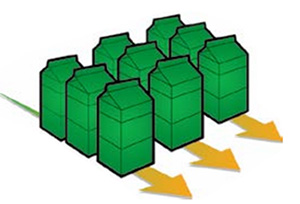
Lots of people start with FIFO when they're considering flow storage, and that's fine. But there are other ways of dealing with it if your density, throughput and concentration factors don't align.
When FIFO is required, your decision is very different. For instance, drive-in systems have excellent depth, but are last-in-first-out.
In selective systems, FIFO is enforced operationally and not by the storage media. That means additional tracking, more careful handling and often extra labor. People have to be cognizant of where pallets are stored, where they're picked from and when they pick them. In high-volume environments, that cost and the informational overhead it causes becomes significant. Pallet flow eliminates that variable. Inventory rotates as it moves through the lane. For industries like food, beverage or pharmaceuticals, this alone can justify the system.
If FIFO is not required, that advantage is less pronounced and lower-cost alternatives become more competitive.
Where pallet flow starts to pay off
When these variables are viewed together, a clearer picture emerges. Pallet flow makes sense when your operational needs cross several thresholds at once.
What could a successful pallet flow case look like?
| Factor | Practical threshold | Notes |
|---|---|---|
| Pallets per SKU | 6-8; ideally higher | Lane depth is sufficient to keep flow lanes consistently utilized |
| Pallet moves per SKU | 15-25+ per day | Labor savings from reduced travel and handling become measurable |
| Inventory per SKU | 50-100+ pallets in the system | Enough volume exists to justify dedicated lanes without fragmentation |
| Density gain vs. selective | 60-80% increase | Space savings begin to offset capital cost or delay expansion and makes up for flexibility loss |
In this example, the system is simultaneously solving multiple problems:
- Increasing storage density,
- Reducing travel,
- Eliminating re-handling,
- Enforced FIFO inventory rotation,
- Reducing handling labor and interactions
Those effects compound, which makes pallet flow strong in high-volume environments.
When you dip below those thresholds, pallet flow benefits tend to isolate. You might gain needed density without enough throughput to justify it. That can be okay, of course. If you need a high-density FIFO system near a certain piece of the operation that can store specific inventory, you may not care about throughput or reduced labor interactions. The density and proximity are enough for your core application.
You should also consider future volume. If you know inventory or throughput will increase, installing a flow system can make sense if you know you'll later need it.
Where do the benefits of pallet flow splinter and decline?
Sometimes pallet flow is specified in situations where it doesn't fully realize its potential. However, if those operations are looking for consolidated storage, point-of-use density or enforced first-in, first-out pallet rotation, these use cases can be perfectly viable without crossing all thresholds for ROI.
- The most common failure cases are straightforward. Shallow inventory (fewer than four pallets per SKU) leads to underfilled lanes.
- High SKU environments create fragmentation.
- Low-throughput operations don't generate enough movement to offset the cost of the system. Your ROI just isn't there.
There are also structural considerations. Pallet flow introduces additional mechanical components: rollers, brakes and guides that require higher quality pallets and periodic maintenance. It introduces safety concerns when people have to enter the structure to deal with jams. It's not as simple or easy to own and maintain as static systems.
None of these things are problems in the right use case, but in the wrong one, they add complexity without a payoff.
Comparison: pallet rack systems vs. pallet flow factors
| Factor | Selective | Push-Back | Drive-In | Pallet Flow |
|---|---|---|---|---|
| Pallets per SKU | 1-3 | 2-6 | 6-12+ | 6-20+ |
| Throughput | Low | Medium | Low-Medium | High |
| Density Gain | Low | Medium (40-60%) | High (60-75%) | High (60-80%) |
| FIFO Capability | No (manually driven at best) | No | Limited (drive-through only) | Yes |
| Cost | Low | Medium | Low-Medium | High |
| Primary Advantage | Maximum selectivity and flexibility | Improved density with minimal complexity | High-density storage at lower cost | High throughput with automatic FIFO |
| Primary Limitation | Low density and high travel time | LIFO storage limits rotation | Low selectivity and slower operation | Higher cost and requires consistent volume |
Pallet flow is usually positioned as a storage density solution, but that's only part of the story
From an ROI and engineering perspective, it's a good idea to turn that idea around and classify it as a throughput-driven system that also gives you great storage density. You can justify it based solely on density, but it's better to be comprehensive in the analysis. When volume is concentrated, movement is high, and it can drive significant improvement. For a comprehensive analysis of your storage needs, contact us today.