








Your shopping cart is currently empty.
Pushback Rack ROI: A Balance
Throughput, storage density and labor costs savings
Ask our Experts!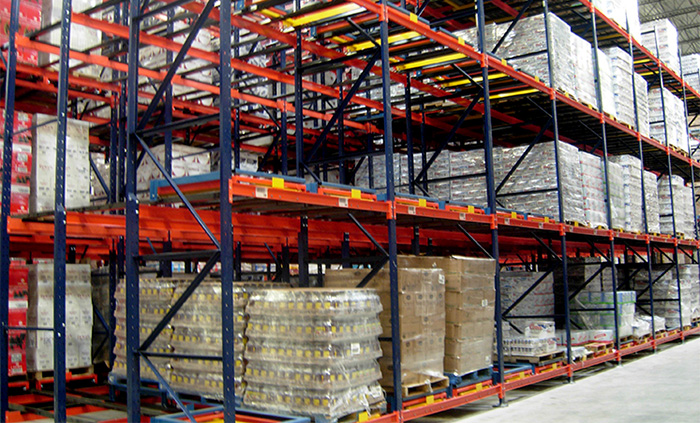
The strongest use cases
Pushback performs best with multiple pallets per SKU and moderate inventory turnover. In a way, pushback is a compromise between the flexibility of selective systems and higher-density drive-in systems.
- You get better selectivity and faster access vs. drive-in systems (by about 400%) but less density.
- You get more density (an estimated 90% improvement) vs. selective systems, but less selectivity. Read more: High Density Pallet Storage: Comparing Pushback vs. Drive-In
| Operational characteristic | Pushback fit |
|---|---|
| Multiple pallets per SKU | Strong fit |
| Medium-turn inventory | Strong fit |
| FIFO required | Not a fit due to LIFO dynamics |
| Limited floor space | Strong fit |
| High SKU diversity per lane | Limited fit |
Pushback is an excellent reserve storage, buffer inventory, and bulk pallet storage system where density matters more than selectivity. You see it used in refrigeration or freezer applications in many cases due to its combination of selectivity, less expensive access and excellent density.
Pushback ROI: the factors you should consider
Pushback ROI shouldn't rely from a single factor—you must consider a blend of pallet storage density, safety, reduced labor costs and smoother operational flow. Many people compare high-density systems only to selective racking. To calculate valid ROI, you should also consider other means, including dynamic rack alternatives.
Labor productivity improvements
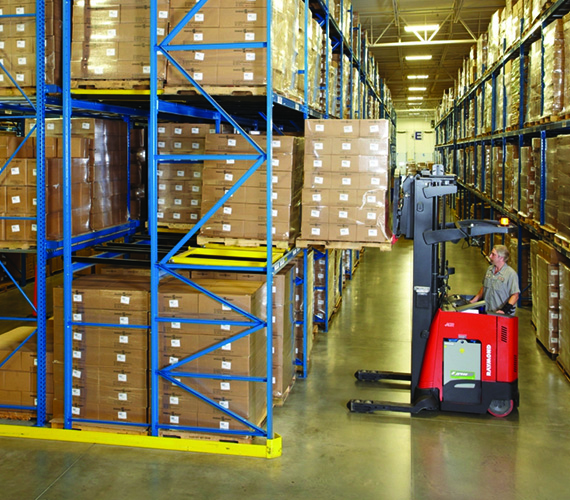
Almost all dynamic rack systems reduce labor reliance by reducing the time it takes to interact with a pallet, whether that's putaway or picking, but pushback is uniquely positioned as the compromise solution that maintains the most selectivity and also concentrates storage.
- Selective systems require a single driver navigate to a single pallet position every time. That's a lot more forklifts and drivers putting on miles every time they need to touch a pallet.
- Unlike drive-in rack, operators don't enter the rack structure, which reduces travel time and simplifies pallet handling. Drivers only access a single pick face from a single aisle.
- Pallet flow requires a deeper aisle of the same SKU, and the need for a FIFO storage to make sense. The single aisle pick/place dynamic is similar, but the economics and inventory requirements are very different.
Pushback sits in the middle, delivering excellent density and good selectivity. This means reduced labor hours and more consistent performance. Drivers' jobs are simplified, so they drive less and pick/place more. They're less vulnerable to decision fatigue.
Product flow and throughput considerations
Pushback systems maintain a consistent pick face for lift trucks to access. They pick and place each lane in the same position so that when a pallet is removed, the next pallet automatically advances into position. This eliminates delays associated with repositioning loads and helps maintain steady workflow. This is higher flow than selective or drive-in systems, but with less depth and density than pallet flow.
The most mission-comparable rack system is drive-in, which provides more density, but slower throughput. For pushback solutions to make sense, you will need faster throughput than drive-in and more density than selective. If either of these things isn't the case, you should evaluate whether pushback systems are the correct solution for you.
Safety and product damage factors
When compared to drive-in, pushback systems provide less opportunity for damage to the rack or the inventory simply because drivers aren't entering rack structure to pick and place. While pushback systems are costlier per-pallet than drive-in, the operational and ongoing costs may bridge the gap.
Cost evaluations
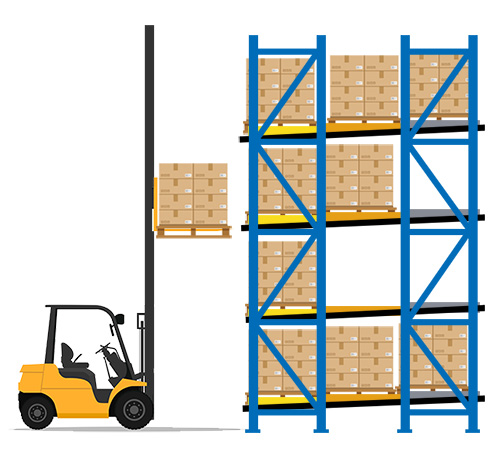
Pushback racking typically involves a higher initial investment than selective pallet racks since it involves engineered solutions and components (carts, rails). That initial cost can be misleading as the cost of picking and placing is reduced over time. Cost should be evaluated in the context of total system value rather than only the material and installation costs.
- Lane depth: Pushback creates a per-position cost greater than selective or drive-in systems due to the dynamic nature of the pushback carts system. For very shallow pallet needs, would double-deep systems suffice? For even deeper pallet positions, would drive-in suit your application better?
- Pallet weight: For heavier than typical loads (3k+), pushback costs increase vs. static alternatives. Wheels, stops and carts must be built to handle the weight.
- Layout complexity: For more complex layouts, evaluate the design and implementation issues involved with all alternatives.
Comparisons: pushback vs. alternative systems
Pushback racking sits in a middle ground between selective pallet rack and drive-in or flow racking.
| System Type | Density | Cost | Inventory Flow | Operational Complexity |
|---|---|---|---|---|
| Selective Rack | Low | Low | FIFO | Simple |
| Pushback Rack | Medium-High | Moderate | LIFO | Moderate |
| Drive-In Rack | High | Moderate | LIFO | Slower operation |
| Pallet Flow | Very High | High | FIFO | More complex |
ROI calculations
(1) Rack system modeled cost per pallet position
- Selective Rack $75 - $150
- Drive-In Rack $200 - $300
- Pushback Rack $250 - $450
- Pallet Flow $400 - $800+
We start with an estimate per pallet position in various types of storage racks to build the ROI case. These are estimates based on broad industry data, and will change over time as business evolves. For modeling, we assume that these changes can be built in.
(2) Warehouse footage cost assumptions
We assume that warehouse cost per square foot is $8 all-in. This includes leasing, property taxes, insurance, etc. If you know your true cost per foot, use that number.
(3) Density assumptions
This model assumes you are comparing the cost of higher-density LIFO systems vs. baseline selective racking. For this model, we'll use these density improvement assumptions:
- Drive-in: 65%
- Pushback: 50%
Why is pushback lower density than drive-in? Typically this is because pushback systems with angled carts require more vertical space and also tend to offer reduced pallet depth.
(4) Labor assumptions
This may be the most important factor for most operations in terms of ongoing costs. For the model below, we assume $28/hour, which includes wages, benefits and other costs. Labor can be the most unpredictable and least controllable cost.
Throughput: pushback vs. selective vs. drive-in
| System | Avg Cycle Time (min) | Cost per Pallet Access | Cost per Day (200 accesses) |
Cost per Year (50,000 accesses) |
|---|---|---|---|---|
| Selective Rack | 2.6 | $1.21 | $242.67 | $60,666.67 |
| Pushback Rack | 2.1 | $0.98 | $196.00 | $49,000.00 |
| Drive-In Rack | 4.6 | $2.15 | $429.33 | $107,333.33 |
Assumes a fully burdened forklift labor rate of $28/hour, 200 pallet accesses per day, and 250 operating days per year. Actual results will vary based on layout, travel distance, congestion, and operator efficiency. Pushback reduces pallet access time vs. selective due to lessened travel time.
Storage density factors
- Drive-in: Assuming 65% improvement, drive-in racking would allow 8,250 pallets to be stored in the same space. If expanded pallet storage isn't the point, this warehouse would need only 61,000 square feet to store 5,000 pallets.
- Pushback: Assuming 50% density improvement, pushback lets this warehouse store 7,500 pallets in the same space. It allows the operation to recoup 33,000 square feet since it can store the same 5,000 pallets in 67,000 square feet.
| System | Space used (selective = 100k) | Space saved vs. selective | Savings vs. selective |
|---|---|---|---|
| Drive-In | 61,000 sq ft | 39,000 sq ft | $312,000 |
| Pushback | 67,000 sq ft | 33,000 sq ft | $264,000 |
Note: Space savings are calculated at $8 per square foot and are not operational savings. However, if improved storage density prevents an expensive renovation or facility relocation, the financial impact can be significant. These savings also allow companies to task that space to other profitable uses.