








Your shopping cart is currently empty.
A new conveyor system connects the operation from end to end
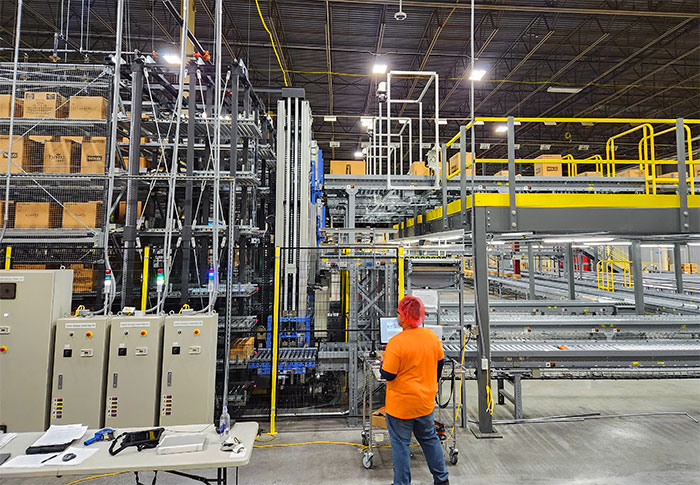
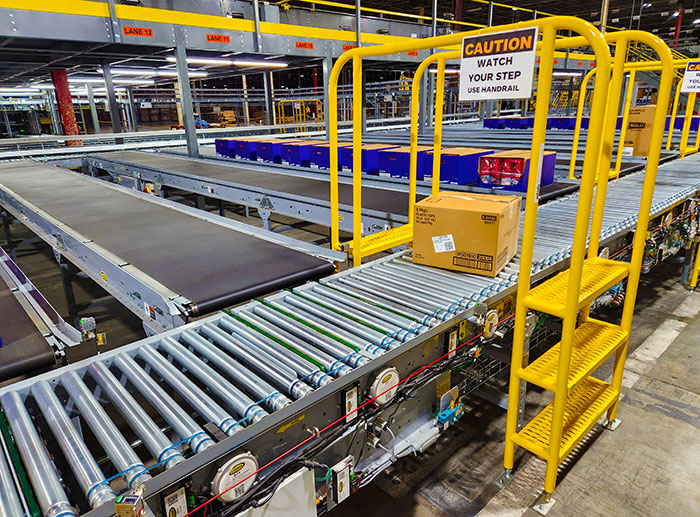
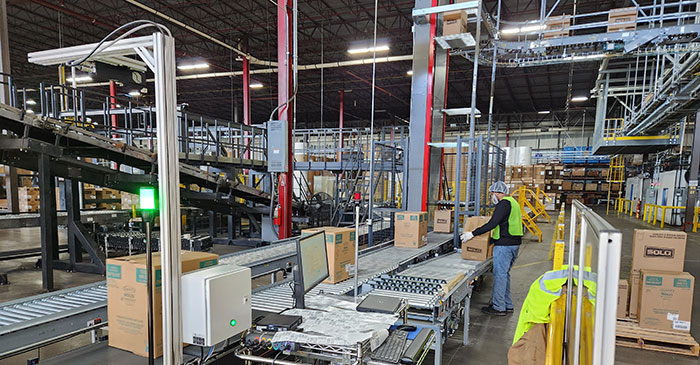
The system integrates with four departments in four different warehouse areas, transporting cases of finished product on 750 feet of overhead accumulation conveyors, where it sorts cases to final destinations.
Cases are scanned to determine direction, then automatically sorted. Larger cases are turned onto their sides and sent either to floor storage lanes. All other cases are sorted to AS/RS.
Sorting to the correct destination, at speed
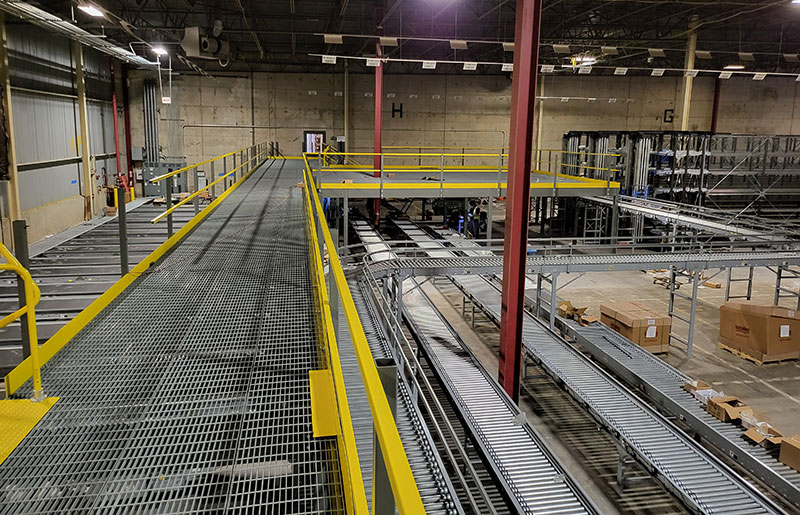
AS/RS Sortation
Once scanned, cases are sent to another sorter, where three infeed accumulation lanes feed the system. The cases are rescanned at the conveyor discharge prior to entering the AS/RS to ensure proper slotting.
Read more: When is an AS/RS System a Good Fit?
Floor storage sortation
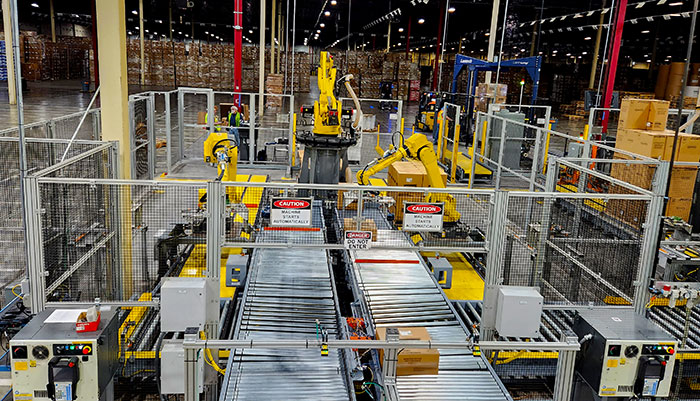
16 floor storage lanes accumulate to palletization. Cases are released to be palletized once full quantity is reached. A robotic palletizer handles display cases and picks the cases from beneath. A second palletizer handles oversized cases with a suction end effector.
Read more: Palletizing analysis
The system combines flexible storage functionality with high-capacity transport and sequencing for handling a mixture of various sized boxes and totes on the fly while buffering cases between production and palletizing. The system handles a wide variety of assorted sizes with the same device for simple, faster handling.
The sortation sequence
- When enough cases to create a full pallet accumulate within the AS/RS system, they discharge onto conveyors that feed three palletizing cells.
- Cases sent to palletizing are sorted to the correct cell.
- A small robot orients the cases correctly for layer building on a pallet.
- Once cases are oriented, a larger robot picks up multiple cases to build the pallet—completely free of human intervention.
The palletizing cell—which dispenses three different types based on the case type—builds up to five simultaneous pallets at lightning-fast speeds. Once pallets are completed, they are dispensed from pallet build lanes to automated stretch wrappers.
A fourth discharge lane conveys cases from the AS/RS system to a hand stacking lane.
The system integrates the new AS/RS storage/sortation automation with customized software to communicate with the facility's enterprise software for routing, case management and palletization.
To facilitate a smooth transition, a personalized onsite team managed project planning and supervised installation, including existing equipment demolition, receiving and unloading.
The results
The sortation system successfully stores and manages over 90% of SKUs and transports all cases from all departments completely to a wrapped load, meeting 24/7 production schedules without manual handling or interactions. This met the goal of increasing production without adding additional labor.
| System step | Operational description | Result |
|---|---|---|
| 1. Cases enter the system | Finished cases from four production areas enter an integrated overhead accumulation conveyor system. Cases are scanned to identify their destination and handling requirements. | Creates a single automated material flow connecting production with storage, palletizing and shipping preparation. |
| 2. Cases are sorted | The system automatically directs cases based on size and destination. Larger cases may be turned on their sides and routed to floor-storage lanes, while most other cases are sent toward the AS/RS. | Automatically manages a wide range of case sizes and reduces manual routing and handling decisions. |
| 3. Product is buffered and stored | Cases entering the AS/RS are scanned again for proper slotting. The system stores and buffers product until enough cases are available to build complete pallet loads. Floor-storage lanes provide additional accumulation for selected products. | Buffers production from palletizing while allowing the system to store and manage more than 90% of SKUs. |
| 4. Cases are released in sequence | When sufficient cases are available for a pallet, the AS/RS releases them in the correct quantity and sequence and routes them to the appropriate palletizing cell. | Provides palletizers with exactly the products they need, in the correct order, without manual sequencing. |
| 5. Robots build pallets | A smaller robot orients cases for the required pallet pattern. A larger robot then picks multiple cases and builds the pallet. Specialized palletizers handle display and oversized cases. | Removes repetitive manual stacking while increasing consistency, ergonomics and palletizing speed. |
| 6. Completed pallets are wrapped | Finished pallets leave the pallet-building lanes and are automatically conveyed to stretch wrappers. | Cases can travel from production departments through to a finished wrapped load with virtually no manual handling. |
| 7. Controls coordinate the process | Customized software communicates with the facility's enterprise systems to control routing, case management, sequencing and palletization. Weight and dimensional checks verify cases as they move through the system. | Improves routing accuracy, supports varying product characteristics and provides operators with tools for exception handling and recovery. |
| Overall result | The integrated conveyor, AS/RS, sortation and robotic palletizing system operates around the clock and can manage more than 100 unique batches at one time. | More than 3,000 cases per hour and double the previous overall output, without adding additional labor. |
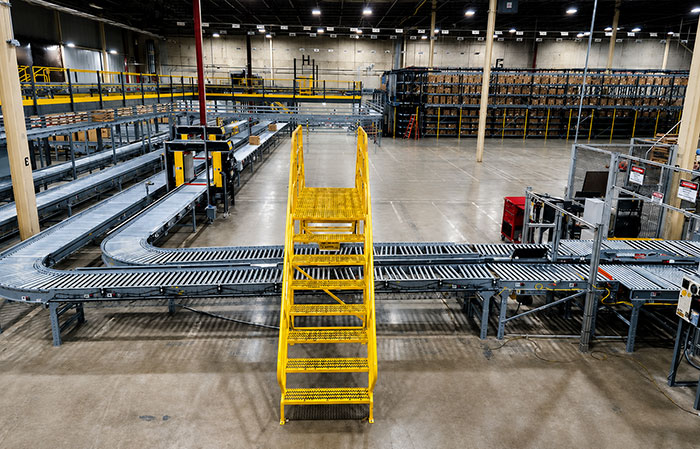
The ability to buffer and deliver cases to the palletizer in exact sequence and quantity without manual intervention, error, or damage exceeded throughput targets. The new system handles more than 3,000 in/out cases per hour of 100-plus unique batches at any time—all while doubling overall output.
The system performs weight & dimensional checks on each case before leaving departments, allowing system adaptability and new product characteristics, including different materials and sizes.
Manual intervention operator controls optimize in-process performance and throughput while allowing error-handling or recovery procedures, increasing accuracy and overall production efficiency.
Ready to invest in future growth? Contact us today.