






Your shopping cart is currently empty.
Rug Finishing Plant Conveyor System to Improves Customer Service, Ergonomics
Pre-planning and performance goal clarification paid off
Ask Our Experts!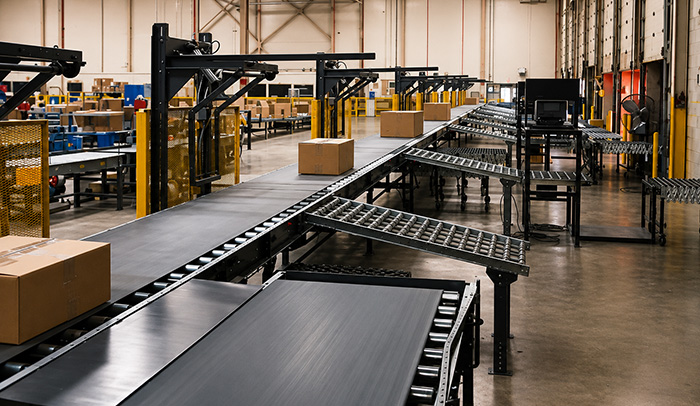
Details:
- Location: Arkansas
- Company type: Carpets and rugs finishing
- NAICS: 313210
- Primary solution: Integrated conveyor system
Application
A leading manufacturer of area rugs operates three facilities: a spinning plant and two finishing plants. At the spinning plant, raw fiber is spun into yarn. The yarn is shipped to the first finishing plant where it is tufted into rugs. The rugs are then transported to the second finishing plant for coating, dyeing, and other finishing operations before returning to the first facility for storage, packing, and shipment to customers.
The situation
Prior to the installation of the new conveyor system, the plant used two parallel lines of powered roller conveyor to move cartons of finished rugs through the packing process. The cartons moved by power conveyor to a taper, followed by a strapper. Next, the cartons, which were then ready to ship, were manually moved to trailers or a floor staging area.
When an item in the floor staging area was due to be shipped, employees used hand trucks or dollies to move it to dock bays and into outgoing trailers. Because all of the carton handling in this area of the plant was performed manually, management was concerned about the potential for handling-related injuries.
The desired solution

- Create a more ergonomically correct workplace
- Substantially improve material handling processes
- Increase operational flexibility and responsiveness
- Integrate automatic data collection into the operations
- Enhance customer service
- Improve flexibility
The plant's industrial engineering team partnered with Cisco-Eagle to analyze the shortcomings of the existing design and co-develop a new approach that links together all of the operations in the area with a single, powered conveyor system.
"What we wanted to do," explained the project's lead industrial engineer, "was to try to meet several different goals using one system. We wanted to create a better, more ergonomically correct workplace for our employees. We knew that we couldn't eliminate all of the manual handling in this area, but we felt that we could substantially improve our material handling operations. In addition, we wanted to improve our ability to meet customer needs. To do that, we needed to make the operations in this area more flexible and more responsive. Integrating automatic data collection into these operations was also a priority. And of course, we needed to be able to cost-justify any new system that we chose. We really wanted to modernize these operations."
Solution implemented
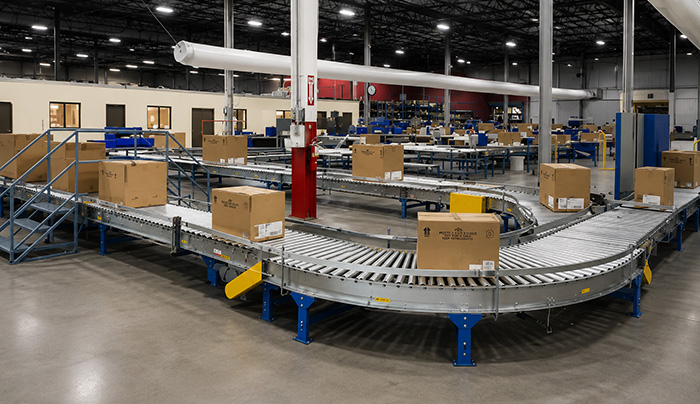
Working over the course of two long weekends, the customer's project team partnered with the field installation crew from Cisco-Eagle to install the new conveyor system. According to the project team, this approach to scheduling minimized downtime in the packing and shipping area. The pre-planning and careful identification of performance goals paid off in a quick ramp-up and a system that closely matched the plant's operational requirements.
With the new conveyor system in place, work begins as orders are received electronically from the company's corporate systems. When the inventory control system determines that all of the items required to complete an order are available, the rugs are loaded into totes and released to the packing area.
The totes are then transported to points alongside the plant's two parallel lines of packing workstations. Here, rugs are packed into a wide variety of carton sizes. Workers also attach customer-specific labels to each rug and apply a bar code label to the outside of each carton. Once packed, the employee slides the carton onto an outgoing conveyor for transport to taping. The two conveyor lines coming from packing merge before feeding the cartons into strapping and taping machines.
Next, the cartons flow into a long loop of minimum-pressure accumulation conveyor. They then travel through a scanning location where their dock destination is determined. This information is transferred to the system's primary logic controller, which activates an overhead pusher at the appropriate dock location. The cartons then flow onto an extendible conveyor that transports them into trailers for loading. Because of the added conveyor automation in the sorting and packing process, the benefits of the new system were immediately apparent to employees working in the packing and shipping operation.
The results:
Much of the potential for handling-related injuries was reduced or eliminated. Customer service, shipping flexibility, and overall operational responsiveness improved, while order fulfillment and shipping errors were reduced.
Facility information:
- Products Manufactured: scatter rugs and area rugs
- Total Square Feet: 175,000
- Number of employees: 1,200
- Maximum daily throughput: 8,000 to 9,000 cartons
- Average daily throughput: 3,500 cartons
- Total length of conveyor system: 440 feet
- Type of sortation: overhead pusher
- Merge points: two with a "traffic cop"