






Your shopping cart is currently empty.
Smoother, More Efficient Operations: TTI's Material Handling System
"Our customer feedback recognizes our warehouse and operational capability as being industry-best"
Ask Our Experts!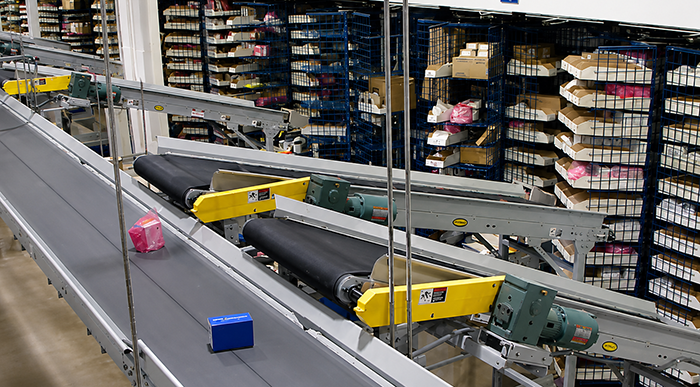
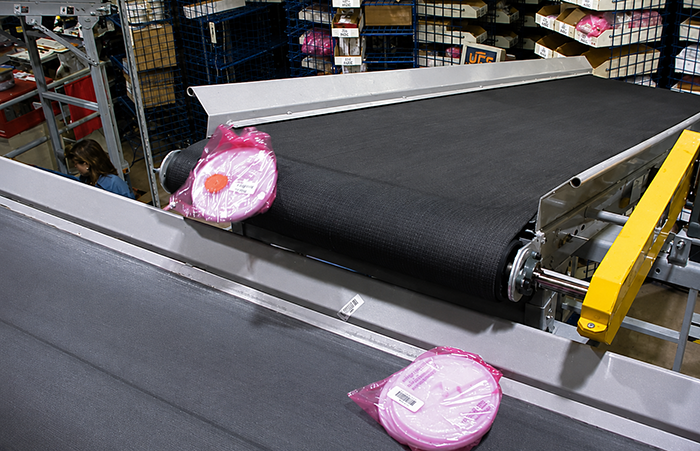
Above: The Main Trunk utilizes a "waterfall effect" to sort and protect various sizes of conveyed products. Often, these products are fragile, and protecting them is a primary achievement of the system.
Customer
TTI, Inc. - www.ttiinc.com
Details:
- Location: Fort Worth, TX
- Company type: Passive electronics distribution operation
- NAICS: 423690
- Primary solution: Belt conveyor system with pick module and shipping area integration
The situation
TTI, Inc. distributes passive electronics products, which are the lowest unit-priced components in the electronics arena. The company has been successful in executing its specialization while the industry as a whole has pursued more glamorous, more costly products such as semiconductors and computer-related products. TTI's business model is designed to simplify the purchase of passives, which allows buyers to concentrate their efforts on the larger dollar expenditures where greater cost savings can be achieved for the time spent. From the beginning, TTI's mission was to offer extensive inventories, exceptional product knowledge, and superior customer service. The company has seen its size double in the past twelve months, and has seen a fivefold increase since 1995.
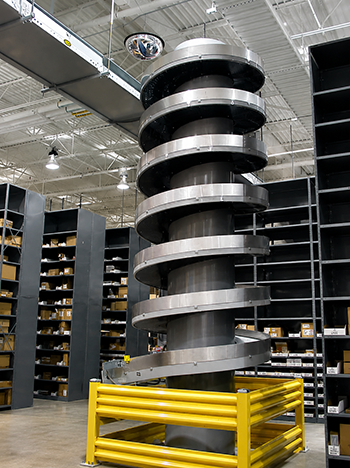
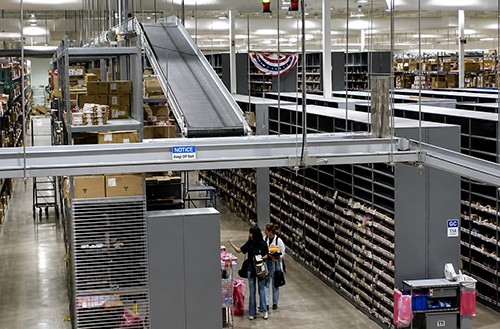
Right: Spiral conveyors transport product onto the elevated conveyor trunk. If incline belt conveyor had been used, the cost in space would have meant five bulk racks of product would have been eliminated.
TTI operates in a business where margins depend on handling products with exceptional efficiency. Many of the components it distributes have very low unit values, making unnecessary handling costly. Every additional touch reduces profitability, so the operation was engineered to move products quickly and directly from receiving through order fulfillment.
With approximately 181,000 SKUs in inventory and roughly 1,000 new part numbers added each week, material flow and storage efficiency are critical. The continual expansion of inventory required a fulfillment process capable of scaling without sacrificing accuracy or speed.
After conducting detailed operational studies and evaluating multiple concepts, TTI concluded that traditional tote-based order fulfillment had become a limiting factor. The company established a clear objective: eliminate totes, enable real-time picking, and transport products efficiently across the facility without relying on conventional floor-mounted roller conveyor.
While outside evaluations suggested that this approach was impractical, TTI chose to pursue the concept internally and collaborated with Cisco-Eagle to develop a solution capable of supporting its operational goals.
The impact
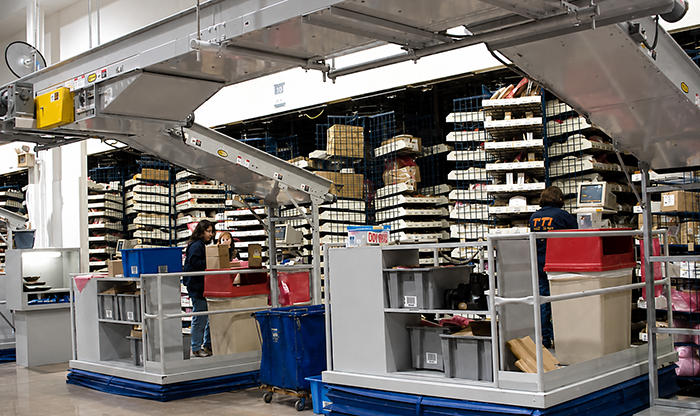
In TTI's previous system, each operator was assigned two carousels, which was considered a pod. Ladders were used to reach the various bins on the carousel. TTI's automated system would assign a tote to each order. At any point in time, TTI had over 4,000 totes in operation. TTI found that managing the totes was becoming a bigger issue than managing the product itself.
Managing thousands of totes had become a significant operational challenge, consuming valuable floor space while adding unnecessary complexity to daily warehouse operations.
Once an item was picked it sat in the tote until other items were complete. This occupied valuable space and slowed the overall process. Upon completion of their picks, the operator would set the tote in front of their workstation awaiting a dedicated delivery person to move it to its next station. This was slow and left the door open for quality issues.
Each time a picker left the workstation to move or retrieve totes, productivity declined and the opportunity for picking errors increased. Reducing unnecessary travel became a primary objective of the redesign.
TTI realized it was not in the business of managing totes, but in the business of efficiently fulfilling customer orders. Operators would often run out of totes since they had to be hand-carried between picking stations and consolidation.
Rapid business growth placed increasing pressure on available warehouse space. Thousands of totes occupied valuable storage and work areas while creating additional handling requirements that slowed the overall fulfillment process.
The results
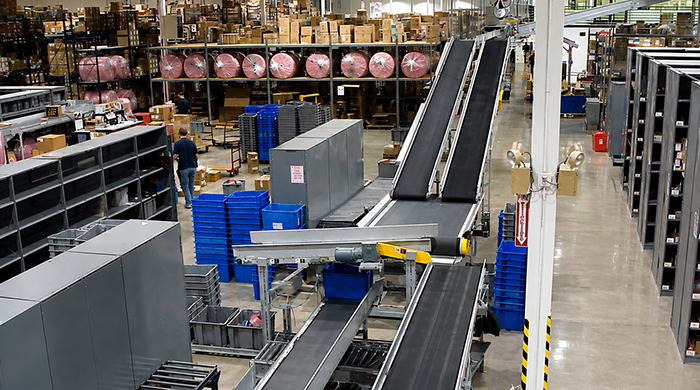
Totes were completely eliminated from the picking operation through a conveyor system that balanced workflow and supported continued business growth. The elevated conveyor network kept travel paths clear, preserved valuable floor space, and avoided the operational compromises associated with floor-level conveyor systems.
The impact was immediate. Productivity increased by approximately 20% on the first day of operation and ultimately improved by roughly 30%. The new process also eliminated the labor previously required to transport thousands of totes throughout the facility, allowing the operation to absorb continued growth without a proportional increase in staffing.
The redesigned operation created a noticeably quieter and more organized warehouse. During a period in which business volume increased by approximately 125%, staffing grew by only about 20%. At the same time, quality improved significantly and order cycle times were substantially reduced.
Orders can now remain in the system later into the day while still shipping the same evening. Instead of waiting in totes for manual transport, picked items are placed directly onto the conveyor and immediately begin moving toward shipping. Delivery time from picking to shipping was reduced from as much as an hour to approximately four minutes, cutting travel time by an estimated 50%.
The conveyor and lift table system exceeded performance expectations by improving productivity, customer service, and overall operational quality. The enhanced fulfillment process also strengthened customer confidence in the company's distribution capabilities.
TTI saw benefits throughout the operation, not just on the processing end. The flow of product improved with single item picking, which allowed elimination of people needed to take totes from one end of the building to the other. The improved flow of the product led to improved performance in the consolidation and shipping areas.
A high priority was to be able to convey fragile components without damaging them. Because of the way the system handles large and small items together, there is virtually no product damage.
Throughout the project, Cisco-Eagle worked collaboratively with TTI to refine concepts, engineer practical solutions, and adapt the system to the company's evolving operational requirements. The implementation team coordinated closely with warehouse personnel to minimize disruption while maintaining a clean and safe work environment during installation.
The completed system improved productivity, quality, customer service, and the overall work environment. By simplifying material flow and reducing unnecessary handling, TTI created a more efficient operation capable of supporting continued growth while delivering faster and more consistent order fulfillment.