






Your shopping cart is currently empty.
Tanning Supply Distributor Slashes Labor 20%, Costs 43%, Enhances Productivity
A whopping 44% increase in sales per dollar of payroll
Ask Our Experts!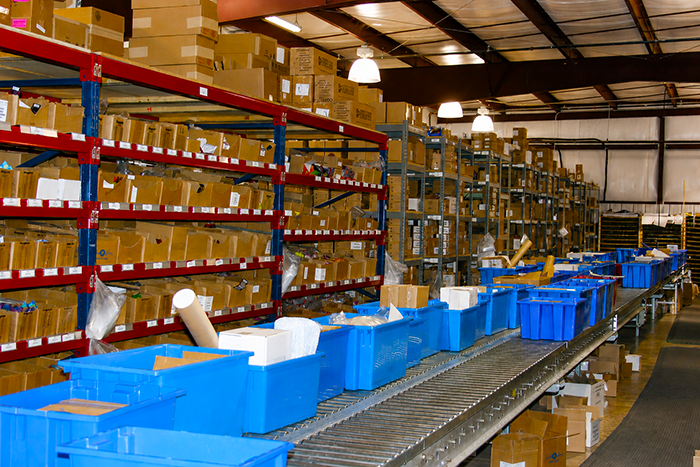
Details:
- Location: Fort Worth, TX
- Company type: Cosmetic supplies distributor
- NAICS: 812112
- Primary solution: Warehouse layout redesign, slotting strategy, kitting upgrades
Imagine 47% annual growth for 10 consecutive years. While that level of expansion is every company's goal, it also creates significant operational challenges for a growing distributor.
As demand increased, the organization's role within its supply chain evolved dramatically, placing greater pressure on warehouse operations and fulfillment capabilities.
The consequences of growth:
Rapid growth created serious space constraints that affected inventory management and order fulfillment. Temporary storage containers provided only a short-term solution.
Approximately 200 of the operation's more than 2,000 SKUs accounted for nearly 80% of order volume. As available space became increasingly limited, access to these fast-moving products slowed, reducing responsiveness to customer demand while making it more difficult to introduce new products and support marketing initiatives.
An earlier warehouse reorganization effort produced few measurable improvements. With continued growth, constructing a new facility was not a practical short-term option. Slow-moving inventory occupied valuable pick locations while frequently ordered products became increasingly difficult to access efficiently.
A comprehensive operational review was needed to address these challenges while creating a foundation for continued growth without sacrificing fulfillment performance.
The solution
The project began by identifying the organization's business objectives and documenting how products and customer orders moved through the fulfillment process. Understanding these workflows provided the foundation for redesigning warehouse operations.
Employee interviews supplemented operational data to identify immediate concerns, including handling current order volumes, as well as longer-term objectives such as supporting projected growth, improving fulfillment efficiency, reducing operating costs, and accommodating changing buying patterns.
Operational data was combined with business objectives and projected growth forecasts to develop a fulfillment model based on proven warehouse design principles. The resulting model guided both the facility layout redesign and supporting operational improvements.
Key elements of the solution included:
- A new layout minimizing walking and search time
- Re-slotting of sku’s based upon volumetrics: size, velocity, special handling needs
- Creation of a work area for kitting
- Dropping select brands and discounting to sell slow movers
| Solution | Rationale | Outcome |
|---|---|---|
| Warehouse layout redesign | Reduce unnecessary travel, improve product flow and eliminate congestion created by years of rapid growth. | Shorter travel paths, improved order processing and additional operational capacity without expanding the facility. |
| SKU re-slotting based on product velocity, size and handling requirements | Place the fastest-moving products in the most accessible locations while relocating slower-moving inventory. | Faster picking, reduced search time and improved responsiveness to customer demand. |
| Inventory rationalization of slow-moving products | Free valuable warehouse space occupied by low-demand inventory that limited access to high-volume items. | Better utilization of storage space and increased accessibility for frequently picked products. |
| Dedicated kitting work area | Create an efficient process for assembling promotional product bundles and custom product combinations. | Expanded value-added services, greater promotional flexibility and more efficient kit assembly. |
| Data-driven fulfillment modeling | Align warehouse operations with projected growth, business objectives and actual order profiles. | A warehouse design capable of supporting continued growth while improving overall operational efficiency. |
| Process improvements focused on labor efficiency | Reduce wasted motion, improve workflow and better utilize available labor resources. |
|
The benefits:
The warehouse improvements delivered measurable operational results:
- A 19% labor reduction
- A 31% reduction in total hours
- A 43% cost reduction
- Distribution factor: a 44% increase in sales per dollar of payroll
Although nearly 75% of annual order volume occurred during a five-month peak season, the redesigned operation reduced the need for overtime and temporary labor during the busiest periods.
The addition of a dedicated kitting area expanded promotional capabilities beyond standard manufacturer packaging options. The operation gained the flexibility to assemble customized product combinations based on customer demand while improving fulfillment efficiency.
The redesigned facility provided additional capacity when demand was highest while improving order processing, increasing usable space, and creating smoother product flow throughout the warehouse.
The project demonstrated how warehouse layout optimization, strategic slotting, inventory rationalization, and dedicated value-added processing areas can significantly improve operational efficiency without requiring a new facility.