








Your shopping cart is currently empty.
How Our Safety Automation Team Works for You
A guide to improving forklift-pedestrian safety
Schedule our team
Think of forklift-pedestrian safety in this light: You want to minimize last-second judgement calls by either drivers or pedestrians in your warehouse by providing guidance, traffic flow, warning systems and exclusion zones whenever possible.
Our goal is to help you understand your safety challenges and recommend solutions that fit your facility, operations and budget.
Our goal is to help you understand your safety challenges and recommend solutions that fit your facility, operations and budget.
How we identify forklift-pedestrian safety problems
How does Cisco-Eagle approach forklift-pedestrian safety analysis?
We start by understanding how your facility operates. We understand where forklifts travel, where employees work and walk, and how often pedestrians and vehicles encounter one another in mixed zones. We work to understand the operational flow and how safety solutions can impact productivity and throughput. We want to help address situations where forklift operators and pedestrians must make snap, quick judgments about their safety.
Considerations include:
- Traffic volume and patterns
- Facility layout and traffic flow within that layout. Where are forklifts going? Where do they most often cross paths with people on foot?
- Vehicle types (forklifts, AGVs, walkies, etc.)
- Operating speeds and throughput needs
- Visibility and sightlines—especially at critical junctures and higher traffic areas
- Employee experience during a typical shift, particularly in areas where traffic patterns create uncertainty or congestion
- Existing safety measures, including training, visibility mirrors, guarding/barriers, mirrors, etc.
What warning signs suggest we need to improve pedestrian protection?
Near misses are an obvious warning, but you don't need to experience an incident to recognize a problem.
Look for pedestrians crossing active forklift aisles without designated crossing points, employees working close to moving equipment, blind intersections, congested staging areas and situations where operators must maneuver around people to complete routine tasks. Pay attention to informal workarounds. If employees routinely leave designated walkways, step around barriers or rely on hand signals to negotiate busy intersections, your current traffic arrangements may not match how the facility actually operates. If drivers complain about having to negotiate an aisle where pickers are constantly working, you may have an actionable warning.
Direct employee feedback is your most important tool. If people complain about forklift traffic and near-accidents, it's a clear sign you need to look at solutions.
How do forklift traffic volume, vehicle speeds and visibility affect safety recommendations?
These factors help determine how frequently people are exposed to moving equipment and how much time they have to recognize and respond. Reducing the frequency of "last second" decision making is critical. A low-traffic crossing with good visibility dictates different protective measures than a fast-paced, multi-directional intersection. Vehicle speed, load size, braking characteristics and available sightlines also influence the appropriate approach. We look at normal operations as well as peak periods. Shift changes, shipping deadlines and production cycles can create traffic conditions that aren't apparent during quieter parts of the day.
Understanding these patterns helps us recommend the right solution for your needs.
What do near misses involving forklifts tell us?

Near misses are the loudest warning you'll get before a serious accident occurs. Near misses reveal traffic problems that haven't yet resulted in an injury or equipment damage. They can indicate poor visibility, confusing routes, inadequate separation or situations where employees and operators must make those quick decisions we're trying to reduce.
- Repeated sudden stops at an intersection may indicate that approaching traffic isn't visible soon enough.
- Pedestrians frequently stepping into vehicle aisles suggest that designated routes are inconvenient, poorly marked or missing entirely.
- If people are hopping guardrails or ignoring mirrors, a near miss is likely to occur.
- We recommend documenting where these events occur, what was happening and whether similar situations have been reported before.
- Identify any near misses and work with your internal EHS function—they may offer guidance on how to proceed.
The goal is to identify recurring conditions and address their underlying causes rather than relying entirely on reminders to be more careful.
What information should we gather?
We don't need significant details to get started. A basic understanding of the problem, the layout and a few details about your facility are usually enough to start a productive conversation. Describe your need as well as you can. We can always fill in the details later. Drawings or photos of problem areas are always helpful when we begin evaluating solutions.
Forklift-pedestrian safety evaluation checklist
Use this checklist to help describe your facility's conditions:
- Identify locations where pedestrians and forklifts regularly interact.
- Document known near misses, accidents or recurring concerns.
- Estimate pedestrian and vehicle traffic during normal and peak operating periods.
- Identify the types of forklifts and other industrial vehicles involved.
- Note vehicle speeds, travel directions and turning movements.
- Identify blind corners, obstructed sightlines and congested areas.
- Review existing walkways, barriers, mirrors, signs and warning systems.
- Note locations where employees must cross active vehicle routes.
- Gather photographs or a basic layout of the areas in question.
- Identify operational constraints, available space and any planned facility changes.
Our Forklift Safety Survey provides a more structured way to document these conditions.
How can we enhance pedestrian safety?
| Evaluation factor | What we consider |
|---|---|
| Hazard and exposure | Type of hazard, severity and frequency of pedestrian-vehicle interactions |
| Facility layout | Traffic patterns, visibility, available space and crossing locations |
| Protection required | Whether communication, warning, physical separation or controlled access is appropriate |
| Cost and maintenance | Initial investment, ongoing maintenance and long-term operating costs |
| Operational impact | Ease of use, workflow efficiency and potential effects on throughput |
Floor striping and signs
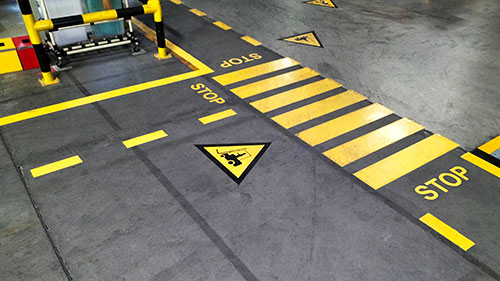
People don't always pay attention to visual cues like striping and safety signs, but that doesn't mean you shouldn't use them. Striping helps organize traffic by identifying pedestrian walkways, vehicle routes, crossing points and restricted areas. You can train more simply as well. There are limits: painted lines and signs don't separate pedestrian and forklift areas. They depend on visibility, maintenance and consistent employee compliance. We recommend that you use these tools to set expectations, but don't expect them to be the end of the story in the sort of limited-visibility, high-traffic zones where decisions must be quickly made by drivers and pedestrians.
Where should pedestrian guardrails and physical barriers be used?
Use barriers like guardrails, machine guards and bollards wherever you can, but remember their role: to separate. A forklift can't drive through a bollard the way it can over floor tape. The problem comes where you cannot separate foot and vehicle traffic.
Barriers are particularly useful along pedestrian walkways, near occupied workstations, around production equipment and at locations where forklifts maneuver close to people. Where you can create barrier-enforced exclusive forklift-only and pedestrian-only areas, we recommend that you do it. Barrier selection depends on the vehicles involved, potential impact conditions, available space and the need for pedestrian or equipment access.
Read more: Where to Add Warehouse Guardrails, and Guard Rails and Impact Ratings from the Cisco-Eagle blog.
Can changing traffic routes or warehouse layouts reduce pedestrian exposure?
Yes. The most effective safety improvement is eliminating needless interactions between people and vehicles.
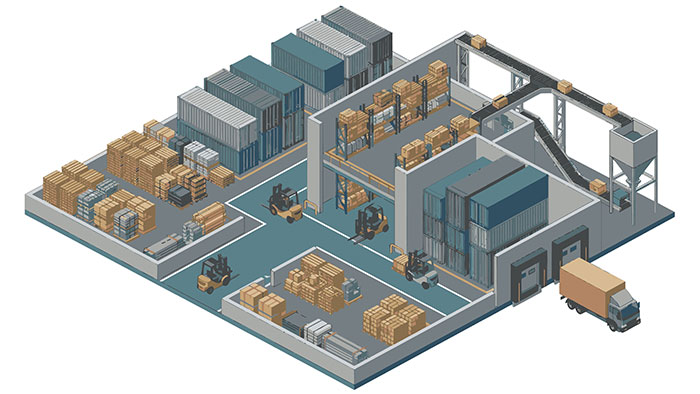
- Example: relocating a pedestrian walkway away from a busy staging area, rack rows or forklift routes may reduce the number of times employees cross forklift traffic.
- Changing a vehicle route, establishing one-way travel or moving a workstation can also help reduce conflicts.
- The ideal situation—where people and forklifts never cross paths—is impossible. Good traffic management design reduces, identifies and manages those places where interaction cannot be limited.
- The objective is to create predictable traffic patterns that support both safety and efficient operations.
How can we improve pedestrian safety without significantly disrupting warehouse operations?
Forklift-pedestrian safety first separates, then manages interaction zones between vehicles (forklifts, AGVs, etc.) and people on foot. The best designed solutions will inevitably disrupt some aspects of material flow in any operation. But you want that disruption. Take the example of driving in a city: you want stoplights, stop signs, crosswalks and other safety measures so that drivers and pedestrians are not forced into decisions every time they interact.
The trick is to incorporate controls into existing facilities without redesigning the entire operation, and that is achievable. The goal is to improve protection while preserving the ability to move materials efficiently.
When more advanced safety systems make sense
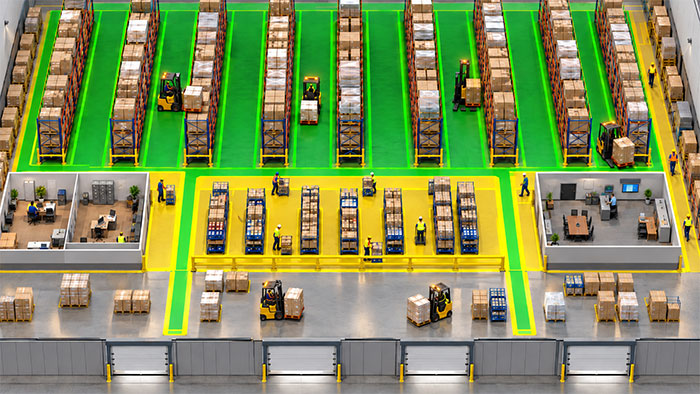
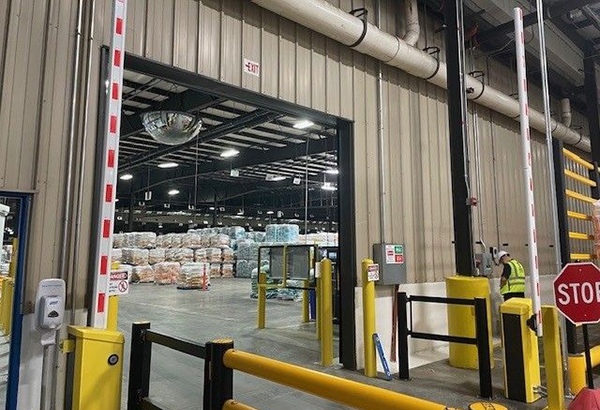
Above: using automated safety system to manage a mixed-use zone
When should we consider automation and advanced sensor systems?
Usually, you'll know.
Automation becomes worth considering when simpler measures don't address recurring traffic conflicts or when a location requires more active control of pedestrian and vehicle movements. If you know a crossing or loading zone frequently puts those critical safety decisions in the hands of drivers and pedestrians, and you can't separate the traffic, it's time to consider gate systems, safety sensors, warnings and proximity protection.
If you're constantly worried about an interaction zone, and can't address it with conventional training and visibility, consider automation.
We don't start the process by assuming automation is necessary. We evaluate the exposure, operating requirements and available alternatives before recommending a particular approach.
How do we decide between barriers, warning systems, gates and other protective measures?
We consider what each measure actually accomplishes.
| Safety measure | Primary function | Best applications | Limitations |
|---|---|---|---|
| Floor markings and signs | Communicate traffic rules and designate travel paths | Defined pedestrian walkways, forklift aisles and low-risk areas | Depend on people seeing and following instructions; provide no physical protection |
| Visibility enhancements and warning systems | Improve visibility and awareness of approaching traffic. Solutions include a wide variety of safety sensors | Blind corners, intersections and areas with obstructed sightlines | Alert people to hazards but don't physically restrict access |
| Guardrails and barriers | Physically separate pedestrians from vehicle traffic | Walkways adjacent to forklift aisles, workstations and high-traffic areas | Require designated openings or crossings; protection depends on barrier design and impact rating |
| Automated gates and traffic controls, including AisleCop and other systems that physically impose barriers | Manage pedestrian and forklift access at intersections | Busy crossings, shared traffic routes and areas with recurring conflicts | Require power, maintenance and proper integration with traffic patterns; effectiveness depends on system design |
Swipe left or right to view the full table.
These measures are interchangeable and tend to work together, but they do not accomplish the same things. A warning light doesn't physically prevent someone from entering a forklift aisle, while a guardrail may provide effective separation but cannot eliminate the need for a controlled crossing. We work to use the best aspects of one or several solutions, depending on the application.
Can a variety of safety technologies be combined into one solution?
Yes. This is often the case. Many applications are better with a combination of warning systems, barriers, gates and alert systems. For example, a busy forklift intersection might use pedestrian guardrails to guide employees toward a designated crossing, floor markings to identify the crossing and automated gates to manage access when vehicles approach. We work to advise you on the right blend of solutions.
Can safety systems be integrated with our existing warehouse equipment and controls?
Depending on the application, yes. AisleCop safety automation can be synchronized with high-speed doors, conveyor systems, warning devices, sensors, gates, robotic work cells and other facility equipment. Cisco-Eagle's engineering and controls capabilities allow us to evaluate these requirements as part of a broader material handling application.
For more detailed information about automated pedestrian gates, traffic-priority configurations and AisleCop technology, see our AisleCop Frequently Asked Questions.
How Cisco-Eagle approaches solution development
| Step | What we discuss | What we want to accomplish |
|---|---|---|
| 1. Define the problem | Discuss the safety concern, whether it involves an intersection, pedestrian walkway, loading dock or multiple areas | Identify the locations and specific problems that need attention |
| 2. Understand the environment | Review how pedestrians and vehicles use the area, traffic patterns and existing protective measures | Understand the operating conditions and potential exposure to hazards |
| 3. Gather information | Review photographs, facility layouts, traffic information and descriptions of known incidents. Additional observation or technical evaluation may be needed | Develop a clearer picture of the application and identify any missing information |
| 4. Explore solutions | Discuss possible approaches, from basic protective measures to automated safety systems | Identify practical options and determine whether further engineering or system design is warranted |
| 5. Determine next steps | Review the available options, additional information needed and potential next steps | Establish a practical path toward an appropriate safety solution |
See more: AisleCop applications—a variety of scenarios and solutions, including video
What happens when we contact Cisco-Eagle about forklift-pedestrian safety?
Our role is to help you understand the available options and develop a practical path forward.
We'll work to understand where the problem occurs, how people and vehicles use the area and what protective measures are already in place. Photographs, facility layouts, traffic information and descriptions of known incidents can help us understand the application. Depending on the complexity of the problem, additional observation or technical evaluation may be appropriate. We frequently work with both operational and EHS teams to define solutions.
Does every forklift-pedestrian safety project require a site visit?
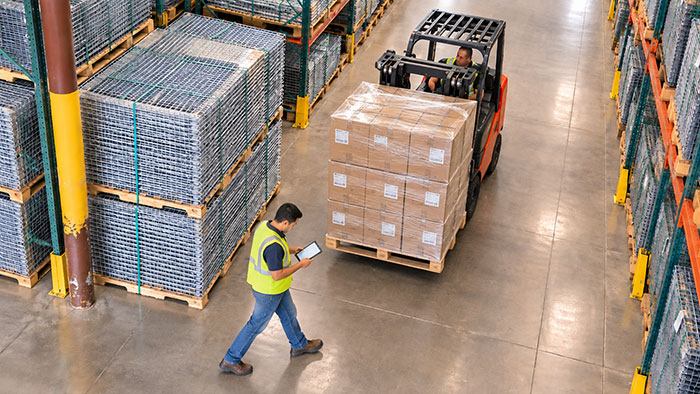
Not necessarily. Some applications can be evaluated through photographs, drawings, traffic descriptions and discussions with facility personnel. More complex applications may benefit from an on-site review to better understand traffic movements, visibility, physical constraints and equipment integration requirements.
How does the Safety Automation Group develop recommendations for my existing facility?
Much, if not most, of our work occurs in existing facilities. We consider the problem, the available space and how the facility must continue operating. Some layouts cannot be changed at all, so we work within the space available when that's the case. An existing warehouse may have pallet racks, conveyors, workstations, doors and building columns that limit where protective equipment can be installed. Traffic routes may also be difficult to change without affecting productivity. We evaluate possible improvements within those constraints. That might involve relocating a pedestrian crossing, adding physical barriers, improving visibility or configuring automated controls around the existing layout.
Can Cisco-Eagle develop solutions for multiple intersections or facility-wide traffic problems?
Yes. This is frequently the case. Some facilities have several locations where forklift and pedestrian movements create similar or interconnected concerns. Traffic changes and safeguards in one position must be in sync with other areas of a material flow or manufacturing operation. Rather than treating every intersection as an isolated application, we can consider how traffic flows within all the affected areas. This often reveals opportunities to standardize protective measures, improve pedestrian routes or coordinate traffic controls, and it ensures the safety system doesn't introduce problems elsewhere in the operation.
Planning and prioritizing safety improvements
Can forklift-pedestrian safety improvements be implemented in phases?
Yes. A phased approach can be practical when a facility has multiple concerns, operational constraints or a limited improvement budget. Sometimes one area must be dealt with before the next can be implemented. It's more efficient to execute all steps at once, but this isn't always possible.
How can we determine whether forklift-pedestrian safety improvements are working?
Safety upgrades aren't measured by what they do. They're measured by what doesn't happen.
Begin by reviewing the conditions that prompted the improvement. Were employees frequently crossing an unprotected aisle? Were operators reporting poor visibility? Did a particular intersection experience repeated near misses? After implementation, observe whether those conditions have changed. Look at pedestrian route compliance, vehicle movements, near-miss reports, employee feedback and the operation of installed protective equipment.
Safety ROI calculation
Learn how to calculate the return on investment for AisleCop forklift-pedestrian safety systems. This guide examines accident costs, insurance impacts, operational disruptions and potential savings to help you build a financial case for improved safety.Common forklift-pedestrian problems and practical solutions
Different conditions call for different approaches. The following table illustrates how Cisco-Eagle may evaluate common traffic problems and the types of improvements worth considering.
| Problem or condition | Potential solution | Important considerations |
|---|---|---|
| Pedestrians aren't following designated routes | Floor striping, signs and walkway improvements | Routes must be convenient, visible and supported by traffic rules |
| Poor visibility at blind corners | Convex mirrors, improved lighting and active warnings | Mirrors improve awareness but don't guarantee detection |
| Pedestrians walk alongside busy forklift aisles | Guardrails and dedicated walkways | Physical separation must account for access and vehicle impact conditions |
| Forklifts travel through congested work areas | Traffic rerouting and layout changes | Changes should reduce exposure without creating new conflicts |
| Pedestrians frequently cross active forklift aisles | Designated crossings, barriers and automated gates | Crossing controls should reflect traffic frequency and operating conditions |
| Forklifts emerge through doors into occupied areas | Detection, warning devices and coordinated access controls | Door operation, sightlines and stopping requirements must be considered |
| Multiple intersections create recurring conflicts | Coordinated traffic management and engineered controls | Different intersections may require different protective measures |
These are potential approaches rather than universal prescriptions. The appropriate solution depends on the hazards, traffic conditions and operating requirements of each facility.
Let's talk about your forklift-pedestrian safety challenges
Improving forklift-pedestrian safety doesn't always require a major automation project. Sometimes a relatively simple change can make a meaningful difference. Other situations call for a coordinated combination of guarding, detection, warning systems and automated traffic controls. Our Safety Automation Group takes a consultative approach to these problems. We help you understand where people and vehicles interact, evaluate practical alternatives and develop solutions that fit your operations.
Start with our Forklift Safety Survey to identify potential problem areas, or call today to discuss your application.
For more information about automated pedestrian safety gates and traffic control technology, visit our AisleCop Frequently Asked Questions.