
Client
A distributor of medical, educational, and other publications.
Details:
- Location: Lewisville, TX
- Company type: Technical publications distribution
- NAICS: 424920
- Primary solution: WMS system with conveyor, carton flow and pick module integration
Application
Upgrade to a distributor's pick, pack and ship operations at its Lewisville, Texas distribution center. The project includes a new Warehouse Management (WMS) System, takeaway conveyor system, shipping area conveyor system, mezzanine, and carton flow storage.
The situation
The distributor provides medical, technical, and educational publications throughout the region. Customer service has long been a competitive advantage, supported by experienced personnel, technology, and responsive operations.
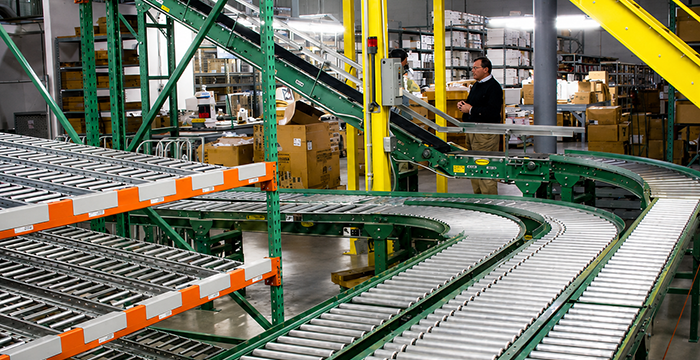
The company had a good problem - its business was growing - but the nature of the business had also changed in recent years, presenting new challenges for distribution operations.
The distributor had consolidated two smaller distribution centers into its Lewisville, TX warehouse and was experiencing high order volumes because of the consolidations and a 50% increase in orders.
“Our answer to increased business had always been more people,” said the Vice President of Distribution.
Customers depended on fast, accurate order fulfillment more than ever before. In the past, they placed larger, less frequent orders. Today, orders arrive more frequently and demand faster fulfillment, requiring the operation to efficiently process orders of any size.
"Our customers utilize us as their warehouse,” the Vice President of Distribution said. “They save money by not having it tied up in inventory. They let us do that.”
Another trend affecting the business was consolidation within the publishing industry. As larger publishers acquired smaller companies, the number of published titles continued to grow, increasing SKU counts and creating greater demands on distribution operations. “If they add 200 new products a year, our SKU’s will reflect that increase,” the Vice President of Distribution said.
The warehouse utilized carts and totes in a manual system to move orders through the facility from picking to packing to shipping.
In the face of a consolidated distribution operation, growing order volumes, and increasing customer expectations, it became clear that the operation required a significant upgrade.
The desired solution
Customer service remained the organization's primary objective. “We have to be error free,” the Vice President of Distribution said.
Leadership recognized that fulfillment operations needed to become more efficient without adding staff. “We had to handle the new business without hiring more people. We turned to the warehouse management system to answer that, so we wouldn’t have to add labor,” the Vice President of Distribution said.
The company inventories 40,000 SKU’s supplied by 350 different publishers. The goal was to improve every aspect of the order fulfillment process, including picking, packing, and shipping.
Solution implemented
The process began with an operational consultation to define WMS and facility requirements. This analysis resulted in the integration of a Warehouse Management System with conveyors and other new material handling equipment to address operational needs.
Consultation process
- High level distribution center plan (phased implementation)
- Definition of what type of software was needed
- Definition of software's functionality
- Selection process for software supplier
- Support of the System's Requirement Document
- Implementation partner
- Final system acceptance
“I want to emphasize the importance of the Systems Requirement Document,” the Vice President of Distribution advised. “If there’s a single step that is the most important, the SRD is far and away number one. There is a great deal of information exchanged and a thorough understanding of the business developed during those sessions. The consulting process helped organize our requirements and identify the right software solution. I don’t know if we would have found the right WMS application without that process.”
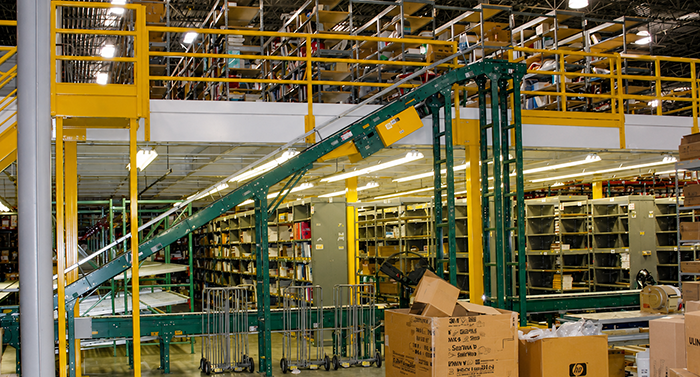
A mezzanine was installed to increase space without requiring a larger facility. The mezzanine hosts slow-moving items and is the beginning pick zone. Incline horizontal belt conveyor connects the mezzanine pick zone to the rest of the facility.
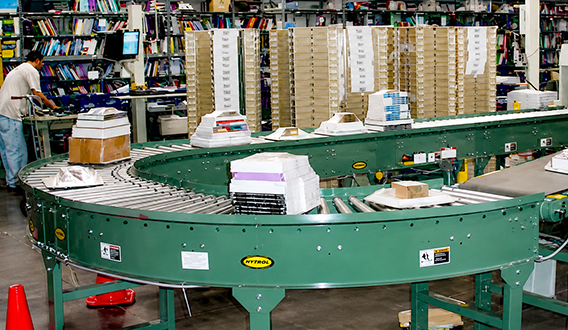
The company utilizes extensive amounts of conveyor in the new operation. Orders are picked into totes and placed on the conveyor to move between pick zones. There are parallel conveyor lines: One for completed orders that transports totes to the quality control and shipping area, and one for yet-to-be-complete orders that conveys totes between various picking zones to be filled.
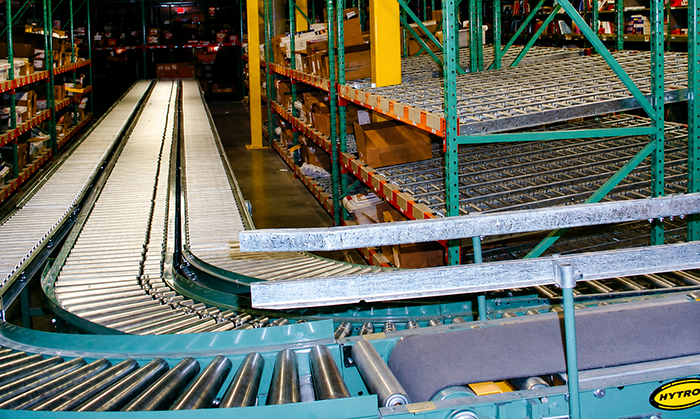
Beneath the mezzanine, the most popular items are stored in carton flow rack, which makes it easier for workers to quickly and efficiently pick and replenish those fast-moving items. The conveyor lines run through intermediate pick zones, where books are picked from rows of industrial rivet shelving. The more frequent the pick, the closer to the conveyor lines it is located. On the opposite side from the takeaway conveyor lines, large bulks of inventory are stored in pallet racks.
“The conveyor let us eliminate carts,” the Vice President of Distribution said. “We’ve eliminated employees having to move carts in this pick and pass scenario.”
The results
When asked how effective the system was, the Vice President of Distribution didn’t hesitate: “The WMS system was more than what we thought it would be. We got efficiencies that I didn’t think we would get.”
The system was designed to increase the operation’s ability to handle escalating business. “Our pickers became more efficient with fewer steps,” the Vice President of Distribution said. “They spend more time picking and less time walking. Access to high-velocity pick positions increased, and we can measure people’s productivity much better than before.”
The system also helped maintain customer service standards by virtually eliminating errors in the order fulfillment process. “We didn’t have a bad error rate before the new system, but we have now eliminated all errors with the WMS. We've had 100% accuracy since the system went live. We have the right items at the right quantities shipping to the right customer.”
The operation was also able to utilize cycle counting to eliminate its annual physical inventory, resulting in yearly savings of $70,000.
Not only did the company avoid a headcount increase to handle the 50% business increase, it actually reduced warehouse staff while continuing to fill orders efficiently.
Additionally, the operation gained more control of warehouse processes than ever before because of the new system. “Because we could control where we locate velocity items - fast movers vs. slow movers - the travel time for pickers was cut dramatically. We never had the tools to track or identify that before,” the Vice President of Distribution said.
“We’re able to measure the productivity of our warehouse, which we’d never been able to do before. It helps us plan labor better. We can get our staff in the right place at the right time in the right numbers. We can plan a day’s work better than we’ve ever been able to.”