








Your shopping cart is currently empty.
AisleCop Frequently Asked Questions
AisleCop systems reduce the dangers of forklift-pedestrian interaction at aisles, crossings and other mixed zones
Let's Talk Pedestrian Safety
System basics
What is the AisleCop forklift safety system?
AisleCop is an automated traffic-control system for areas where pedestrians and forklifts, AGVs, walkies or other industrial vehicles may cross paths.
It uses gates, sensors, warning lights, audible alarms and programmed controls to manage access to a crossing based on the facility's selected traffic rules. It is intended to make interaction zones more controlled and visible.
It is not designed to replace training, traffic rules or other safety measures.
Where is AisleCop typically deployed?

Above: forklift-pedestrian mixed zone in a warehouse aisle with limited visibility
Any zone where pedestrians and industrial vehicles interact are candidates for the AisleCop system. This is frequently in warehouses, distribution centers, cross docks, manufacturing operations, and other areas where forklifts and people mix.
AisleCop systems monitor problematic forklift-pedestrian interaction points like blind corners, limited-visibility crossings, busy intersections, personnel doors that open into forklift areas, shipping docks and crossings near pallet conveyors or automated equipment.
Multiple entrances, diagonal pedestrian routes, robotic work cells and other complex traffic patterns are monitored by these systems. Use AisleCop for any pedestrian/forklift zone where the potential for a pedestrian-forklift accident is possible due to sight lines, speed of operation or volume of crossings.
AisleCop applications and considerations
How does a typical AisleCop crossing work?
In a typical pedestrian-initiated system, a worker presses a button to request access. Sensors scan the vehicle aisle. If traffic is detected, the pedestrian gates remain closed. When the vehicle zone is clear, the system activates its lights and audible warning, closes any vehicle gates included in the configuration and opens the pedestrian gates.
The pedestrian gates remain open while people are detected and for the programmed delay. The system then closes the pedestrian gates, reopens the vehicle gates and returns to standby.
What types of traffic can AisleCop detect?
The sensors can be configured to scan for forklifts and other moving traffic such as AGVs, mobile robots, walkies, stackers and carts. Because motion detectors may treat any moving object in the detection zone as traffic, sensor placement and setup should reflect the actual conditions around the crossing.
Is AisleCop an impact-resistant forklift barrier?
No; it's a visibility and warning system.
AisleCop gates direct and manage traffic flow, but they are not impact-resistant barriers and do not physically stop forklifts or other industrial vehicles. Where impact protection or physical separation is required, facilities should use appropriate guarding or barriers as part of the overall safety plan.
Does AisleCop guarantee that forklift-pedestrian accidents will be prevented?
AisleCop is a safety assistance tool and does not provide 100% protection or guarantee the prevention of accidents, injuries or losses.
Its effectiveness depends on proper system maintenance, driver and pedestrian compliance, enforcement of crossing lanes, accurate assessment of crossing conditions, and other measures controlled by the facility and people who work in the environment. It is an advanced warning system that can be used to reduce the chances of an accident, but like any safety measure, it cannot guarantee an outcome.
Choosing a configuration
What are the physical dimensions of AisleCop systems?
The system is configurable and can work in both cramped and spacious areas of a facility. These dimensions vary based on the arm lengths needed for a given application.
Vehicle and pedestrian gates
| Gate type | Cabinet dimensions | Overall operating dimensions |
|---|---|---|
| Pedestrian gate | 12-1/4" wide × 14-1/4" deep × 37" high | 48" wide when closed with the standard 40" arm; 52-1/4" deep when open |
| Vehicle gate | 13-5/8" wide × 12-1/8" deep × 44" high without the arm | Overall width and raised height depend on the selected arm length |
Gate arm dimension details
Arms can be field cut to specific lengths as required. Below are some examples of arm widths cut to various standard lengths.
| Arm length | Closed Width | Open Width |
|---|---|---|
| 6' | 85-5/8" | 116" |
| 8' | 109-5/8" | 140" |
| 10' | 133-5/8" | 164" |
| 12' | 157-5/8" | 188" |
Your application must allow enough room for each arm's complete 90-degree travel and for the cabinet's maintenance access. The pedestrian arms need 2" to 6" of clearance from adjacent equipment or surfaces as they swing open, while vehicle arms require at least 6". Final placement must also comply with applicable OSHA, NEC, federal, state and local requirements.
By pairing two opposing gates, AisleCop can cover aisles up to 24' spans with opposing gates. Consult with us for longer or more customized requirements.
Other customizations can be made to AisleCop systems to meet the needs of almost any zone where traffic management is required.
What is the difference between a two-gate and four-gate AisleCop system?
A standard two-gate configuration places pedestrian gates on opposite sides of the crossing. Since AisleCop primarily manages pedestrians, those gates are meant to manage their egress. A four-gate configuration adds two vehicle gates, allowing the system to extend arms across vehicle egress lanes.
How do I choose between pedestrian and vehicle priority?
Begin with the normal traffic volume and operating needs at the specific crossing.
Where vehicle traffic dominates, vehicle priority preserves forklift traffic flow. If pedestrian traffic dominates, pedestrian priority may reduce delays for workers on foot. The decision should also consider sightlines, stopping distance, crossing length, congestion, emergency access and the facility's established right-of-way rules.
What is vehicle priority?
Vehicle priority is generally used where forklift traffic is more frequent and is the most frequently used AisleCop configuration. In a two-pedestrian-gate system, the pedestrian gates normally remain closed so industrial vehicles can pass. In a four-gate system, the pedestrian gates normally remain closed while the vehicle gates remain open. Pedestrians request access and cross after the system confirms that the vehicle aisle is clear.
What is pedestrian priority?
Pedestrian priority is generally used where foot traffic is more frequent. The pedestrian gates normally remain open. In a four-gate system, the vehicle gates remain closed until the programmed sequence allows vehicle traffic to cross. This reduces interruptions to the dominant pedestrian flow while still managing the interaction point.
Read more: Pedestrian or Forklift Priority?
Can AisleCop be customized for a complex intersection or application?
Yes. We frequently design and implement complex intersections with controls and sensors built to handle these situations.
Standard Gen5 systems use preprogrammed sequences intended to fit common applications, but customized logic and synchronized multi-gate configurations are available for more complex areas. You should document every pedestrian and vehicle approach, normal traffic state and required sequence before specifying the system.
We will walk you through the design process to ensure that your system meets your safety guidelines and goals.
Can AisleCop manage AGVs, mobile robots or other automated vehicles?
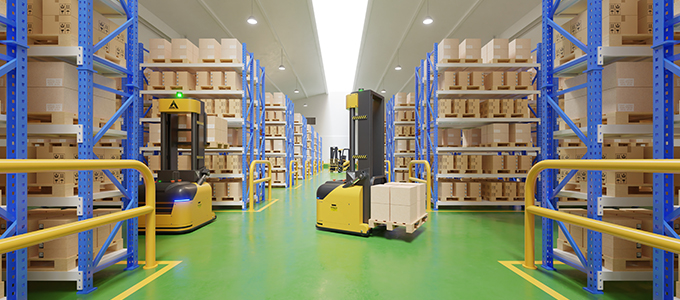
Yes. AisleCop systems work with automated vehicles such as AGVs, LGVs, driverless forklifts, AMRs and others. These unmanned vehicles may require certain interface and activation safeguards and techniques that differ from typical driver-forklift operations.
Sustained signals by AGV system may be required for safe, correct, and consistent operation of safety systems. These signals increase safety in cases where the automated vehicle cannot reliably detect closed gates or pedestrians crossing in the protected zones.
The automated vehicle interlock
- All AisleCop gate systems utilize Allen Bradley PLC technology.
- Sustained signals by AGV system may be required for safe, correct, and consistent operation of safety systems.
- Systems that do not scan for traffic may rely on AGV system to direct opening and closing of gates via dry contact signals.
- Any AGV operations and/or software changes required to accommodate application are by others.
- Any required dry contact relays and associated wiring are by others.
- Automated vehicles should allow ample time for signal to be processed by AisleCop system to open vehicle gate(s), and verify gates are open prior to proceeding.
- Automated vehicles should signal crossing is complete and authorize closing of AisleCop gate.
- Rotation time for vehicle and pedestrian gate arm is approximately 3 seconds (not accounting for auto-reverse resets).
- Vertically acting Vehicle Gates for use of metering Vehicle Traffic only.
- Gates and remote enclosure each require 110VAC power drop. Enclosure: 5-amp FLA. Vehicle gate: 2.5-amp FLA. Pedestrian Gate: 1.0-amp FLA. All 24VDC sensors, field devices, interlocks, etc. as well as power terminations to be terminated by local resources.
Can AisleCop manage manual forklifts and automated vehicles within the same intersection or zone?
AisleCop systems are used to manage both manually driven forklifts and automated vehicles in the same system, area or crossing, but these situations may require controls and other safety modifications to function correctly.
Installation and operation
What power and wiring does a Gen5 AisleCop system require?
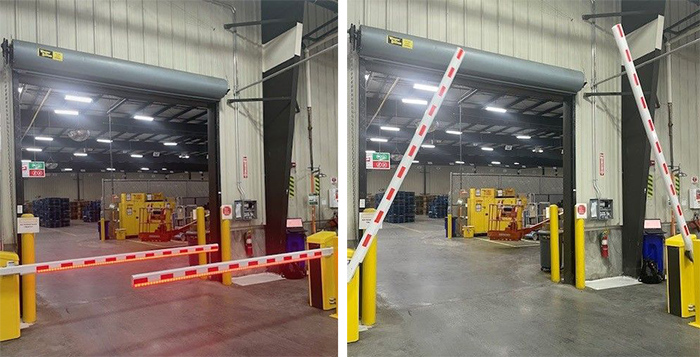
Gen5 pedestrian and vehicle gates require 120 VAC power. The gates communicate through a wireless personal area network, reducing gate-to-gate control wiring. Motion sensors use three-wire connections to the primary pedestrian gate. A clear, unobstructed wireless range of up to 50 feet is specified for standard Gen5 systems.
Custom or modified systems may have differing power and wiring characteristics.
Does wireless communication eliminate all installation wiring?
No. Wireless communication reduces the need for gate-to-gate control wiring, floor trenching and overhead conduit between gates. Each gate requires power, and sensors must be wired to the primary pedestrian gate. Fire-alarm integration, Ethernet access and other project-specific features may require additional connections.
How quickly do AisleCop gates open and close?
The Gen5 manual specifies a two-second opening and two-second closing time for pedestrian gates. Vehicle gates have a specified 2.5-second opening and 2.5-second closing time. The complete crossing cycle also includes sensor checks, programmed delays and time for traffic to clear.
Can AisleCop systems be utilized outdoors, or in extreme environments?
AisleCop systems can operate in outdoor conditions. The gates and arms are all built for outdoor environments, moisture and heat. Some applications may require modifications to controls and wiring for outdoor applications.
The Gen5 manual lists an operating range of -22 degrees F to 131 degrees F (-30 degrees C to 55 degrees C) for both pedestrian and vehicle gates. Site conditions such as moisture, washdown, dust, heat sources and outdoor exposure should still be reviewed before installation. For some extreme conditions, modifications to controls or power systems may be required.
What happens if a gate arm encounters an obstruction?
All gates include an auto-reversing feature. A pedestrian gate arm reverses in either direction until it no longer contacts the obstruction, then continues its cycle. A vehicle gate arm reverses when it encounters an obstruction while moving downward. Even with this feature, the gate's swing area must be kept clear.
What happens during a power failure?
Pedestrian gates do not automatically open when power fails but can be physically pushed open with little effort. Emergency procedures should account for this behavior and meet applicable codes and facility requirements.
Can AisleCop connect to a fire alarm system?
Yes. When properly wired, the PLC can receive a fire-alarm signal and command all gates to open while warning lights and audible alarms continue to pulse. Pedestrian arms may partially block the vehicle aisle in this condition, so operators should leave their vehicles and follow the facility's emergency protocol.
Can the system be remotely supported?
Gen5 systems include Ethernet-capable PLCs. If Ethernet connectivity is set up, Cisco-Eagle can use it for remote troubleshooting and small program changes that might otherwise require a site visit. The customer's IT team controls network setup and may leave the Ethernet cable disconnected until remote access is requested.
Who should install an AisleCop system?
Assembly and installation tasks should be completed by specialists or electrical personnel. Installation must follow the supplied drawings, anchoring instructions, required clearances and applicable OSHA, NEC, federal, state and local requirements. Vehicle barrier-arm installation is recommended as a two-person task.
We can help you with an installation quote or support for your own personnel, or contractors of your choice.
Does AisleCop require maintenance?
AisleCop is designed for a long service life with relatively little maintenance, but the prescribed inspection, cleaning and maintenance schedule must be followed. Facilities should clean gate housings and arms regularly, inspect for wear, verify safety functions and shorten maintenance intervals if operating conditions cause increased wear.
See our maintenance page for more details.
Safety planning, fulfillment and business case
What is the current typical lead time for standard and customized systems?
While lead times can fluctuate based on demand, quantities, inventories and other factors, standard Gen5 systems ship in about two weeks.
Customized system lead times are longer, as the degree of customization, plant layout factors, controls and programming and synchronization with operational systems in your facility can affect the system. Lead times for custom systems are always part of the design and proposal process.
Why is forklift-pedestrian separation important?
OSHA advises separating forklift traffic from workers and pedestrians wherever possible. Its guidance recommends measures such as pedestrian walkways, protective barriers, floor striping, convex mirrors, traffic-control signs and posted speed limits. AisleCop may be useful at defined interaction points where pedestrian and vehicle routes still have to cross, but it should be used as one layer in a broader traffic-management plan.
Where should a facility begin when evaluating forklift-pedestrian risk?
Start by mapping pedestrian paths, forklift routes and every point where the two interact. Then assess each crossing for traffic volume, visibility, driver and pedestrian behavior, existing controls and the severity and likelihood of an incident. This helps prioritize the highest-risk locations and determine whether separation, barriers, procedural controls, warning systems, automated gates or a combination is appropriate.
What behaviors remain necessary after AisleCop is installed?
All safety driven training and behaviors should be maintained. To maximize the system's effectiveness, you must also train pedestrians and drivers to interact correctly with the system.
Drivers and pedestrians must continue following the facility's safety rules. OSHA advises drivers to slow down, stop and sound the horn at intersections, corners and obstructed-visibility locations, maintain a clear view and yield to pedestrians. Workers on foot should use designated walkways, remain clear of operating lift trucks and account for blind spots and rear-end swing. A safety gate system does not remove these responsibilities.
What is the standard product warranty for each Gen5 system and its components?
Warranty Period and Conditions. The Equipment Warranty in the Proposal Terms applies to the Product for one (1) year from the date of shipment or two million (2,000,000) gate cycles, whichever occurs first, and only while the Product is installed in accordance with Cisco-Eagle's installation instructions and operated and maintained in accordance with the AisleCop Installation and Service Manual (the "Manual"). If Cisco-Eagle determines that a defective part cannot practicably be repaired or replaced, Cisco-Eagle may instead refund the portion of the purchase price allocable to that part. Components not manufactured by Cisco-Eagle are covered only by their manufacturer's warranty, which Cisco-Eagle will pass through to Customer to the extent transferable. See AisleCop extended terms for more details
Do AisleCop systems conform to OSHA or other standards?
These sorts of standards don't address systems like AisleCop, but do discuss separating forklifts and pedestrians. OSHA does state: "OSHA requires that permanent aisles and passageways be free from obstructions and appropriately marked where mechanical handling equipment is used." The agency recommends that pedestrians and forklifts should be separated using pedestrian walkways, railings, barriers, floor striping, etc. AisleCop enhances the situations where barriers aren't possible and striping, training and warnings are considered inadequate.
The agency also recommends mirrors and traffic control signs.OSHA standards typically do not deal with these sorts of safeguards. AisleCop systems are safety tools for managing forklift and pedestrian traffic—not impact-resistant barriers or a replacement for a complete workplace safety program.
How can we evaluate the potential ROI of AisleCop?
ROI for preventative safety is often a difficult evaluation, but there are ways to quantify it in terms of a business case for preventing accidents. This white paper documents one way you can estimate ROI for forklift-pedestrian systems.
One way to establish ROI is to compare the installed system cost with the facility's exposure to direct and indirect incident costs over a defined period. Direct costs may include medical care, property damage and legal expenses. Indirect costs may include downtime, administrative time, lost productivity, higher insurance costs, employee concerns and reputational damage. ROI estimates should be treated as a scenario, not a promise, as many factors and internal safety practices can impact calculations.