



Why the Best Warehouse Designs Balance Density and Access
Ceiling height, rack design, and access speed alignment
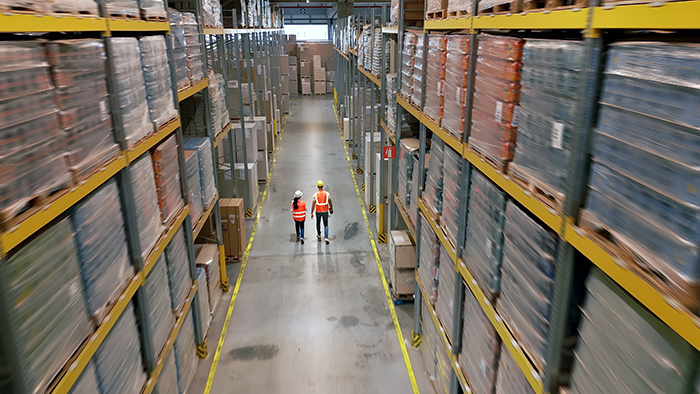
Warehouse buildings have been getting taller: what was once a 16 to 18 foot clear-height facility is now commonly 32 to 40 feet. The logic is straightforward: taller buildings unlock more vertical storage, allowing operators to store more product without expanding the footprint. If you’re in an expensive, landlocked area and need more storage, you need to unlock every vertical inch. High bay pallet rack systems let you use all that air space and can massively increase storage density.
This is a good thing. Until it isn’t.
Not all pallet positions are equal
When you can access a pallet in seconds, it delivers far more value than one that takes minutes to retrieve.
The real question isn’t how many pallets fit inside the building—it’s how quickly inventory can move through it. If you’re storing more but taking more time to access it, that may be an issue. High bay systems maximize cube utilization, but they may introduce unintended friction that slows response time and reduces flexibility.
Speed, flexibility and customer responsiveness deserve close attention when evaluating height vs. efficiency. What are the factors?
The effect of height on throughput
Pulling a pallet from 35 feet takes longer than pulling one from 15 feet and the amount of optimization changes that reality. When inventory turns are slow, or if you’re engaging in longer-term buffer storage, this can be perfectly fine. But if your inventory turns every two weeks—or even faster—it becomes a constraint.
A warehouse can have thousands of pallet positions available and still struggle if pick rates and replenishment cycles can’t keep pace with demand. In high-velocity environments, density that slows throughput quickly becomes a liability.
As rack heights increase, equipment options narrow
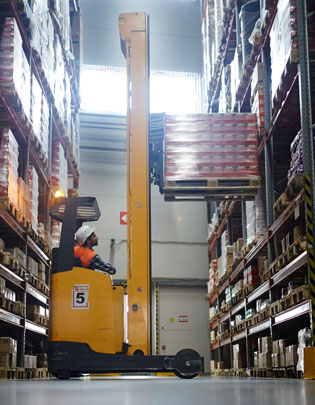
Standard sit-down forklifts do not efficiently operate at 35 to 40 feet. Even conventional reach trucks run up against practical limits well below those heights. Tall rack systems often force operators to use turret trucks or wire-guided very narrow aisle equipment to pick at height.
These systems can be double the cost of standard reach trucks and introduce additional complexity.
- This equipment requires specialized operator training.
- Specialization reduces labor flexibility, as the skills required to do basic pallet picking/transport are rarer.
- Taller racks may also present inspection and maintenance issues.
- There are safety and accessibility issues inherent to higher bay operations.
- Aside from forklift costs, consider the cost of the racking itself as you consider higher-density storage.
Read more: How to Safely and Effectively Load & Unload Tall Pallet Racks
Taller buildings deliver value only when you put that height to productive use
High ceilings quietly increase costs because operators pay for air they don’t use. If you have a 40′ clear ceiling and only stack four pallets high, you’re paying to heat, cool and light 10 to 15 feet of dead air. In climate-controlled markets, those costs compound week after week, month after month over the lifetime of your lease or purchase.
Your facility may constrain higher bay storage
Even when the ceiling height exists, the building itself may limit how much vertical storage is possible.
- Slab thickness and load capacity can cap rack height due to concentrated point loads.
- Slab flatness becomes critical for very narrow aisle and high-reach equipment.
- Fire suppression systems and commodity class ratings—especially for plastics or flammable materials—often impose strict limits on allowable storage height.
Any one of these factors can prevent full utilization of a 36- or 40-foot building, regardless of what the ceiling allows.
This article focuses on the limitations of larger scale selective rack systems. However, higher density systems such as pallet flow, drive-in and pushback racking can significantly affect density and access for the right applications. See video for details.
Slotting for speed: the speed bay concept
Vertical density is rarely applied throughout the footprint of large facilities that we have seen. Some zones use every inch, and zones that do not. That’s the nature of warehousing.
- Slot inventory by velocity. Fast-moving SKUs should reside at floor level or in low-elevation “speed-bay” locations where access is fastest and least expensive.
- Medium movers occupy mid-level positions,
- Slow-moving inventory and reserve stock can be stored at the highest positions.
If you’re only looking at cube utilization, fast pick, speed-bay storage looks inefficient, even though it delivers fast picking and placement for critical inventory. Those fast-pick bays can be the most valuable storage positions in the warehouse when analyzed by business case. These bays drive performance while reserve storage quietly supports it.
Comparisons: balancing density, access, and throughput
| Factor | High density/high ceilings | Faster access/lower density |
|---|---|---|
| Primary Goal | Maximize pallet positions per square foot | Maximize pick speed and responsiveness |
| Typical Rack Height | 30–40+ feet | Floor level to 20 feet |
| Best Use Case | Slow-moving SKUs, reserve inventory, long dwell time | Fast-moving SKUs, frequent picks, short dwell time |
| Speed to Market | Slower access due to vertical travel | Fastest possible access |
| Throughput Impact | Can constrain throughput if high bay positions are overused | Supports high throughput and demand spikes |
| Equipment Required | Turret trucks, wire-guided VNA, AS/RS | Standard sit-down or reach trucks |
| Equipment Cost | High (sometimes double cost of standard forklift equipment) | Lower, more flexible; standard lift trucks |
| Labor Flexibility | Limited; specialized training required | High; easier cross-training |
| Vertical Travel Time | Significant and unavoidable | Minimal |
| Energy & Utilities | Higher cubic volume to heat, cool and light | Lower energy intensity |
| Building Dependencies | High slab capacity, tight flatness, advanced fire protection | More forgiving building requirements |
| Fire Code Sensitivity | Commodity class and sprinkler design can limit height | Lower—simpler compliance |
| Scalability | Good for future capacity if infrastructure allows | Scales with labor and floor space |
| Operational Risk | Higher if SKU velocity or demand changes | Lower; more adaptable |
| Cost Efficiency | Efficient per pallet stored | Efficient per pallet moved |
| Failure Mode | Great capacity, slower inventory access | Great access, limited reserve capacity |
What begins as a storage decision becomes an equipment and labor strategy decision
Height creates opportunity. Operations determine whether it becomes value. Height lets you expand vertically if you aren’t using it today. It lets you absorb seasonal spikes and longer cycle inventory. Height is your friend most of the time. However, if your business case and your inventory mix make sense, higher bay storage is an optimized strategy. If you are looking at or have a tall building with air space you don’t need, that’s fine. The argument isn’t that you shouldn’t pursue high bay options: it’s that you must weigh density with throughput, flexibility and other business needs.
The right solution balances storage density, throughput, speed to market, capital cost, operating cost and the realities of the facility’s location, situation and value. Evaluate these factors to be sure you are making the right business case.
Scott Stone is Cisco-Eagle's Vice President of Marketing with 35 years of experience in material handling, warehousing and industrial operations. His work is published in multiple industry journals an websites on a variety of warehousing topics. He writes about automation, warehousing, safety, manufacturing and other areas of concern for industrial operations and those who operate them.