




Employee Spotlight – Alfredo Arpero
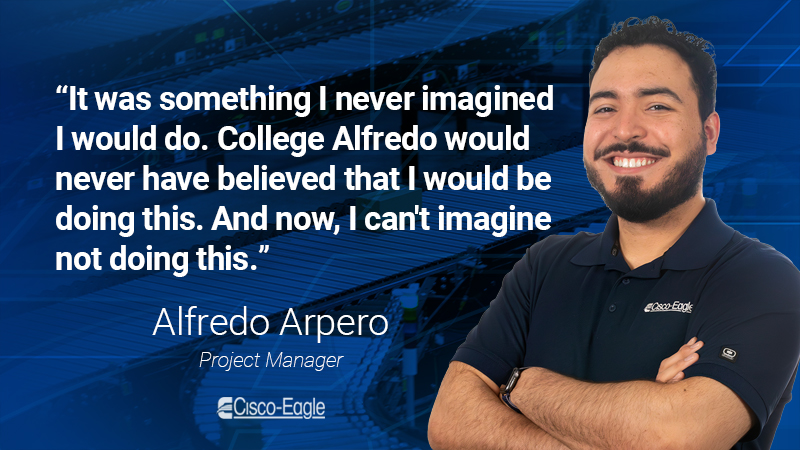
In this edition of the Employee Spotlight, we sit down with Alfredo Arpero, a Project Manager based out of our Dallas office.
We talked with him about how he got here, what the job actually looks like day-to-day, and why being an owner at Cisco-Eagle means something more than a line on a retirement statement.
What was your journey to Cisco-Eagle?
I went to school for mechanical engineering, and that’s what I thought I wanted to do. I got a job in mechanical design out of school, and I liked the work, but it increasingly felt thankless. A lot of pressure with not much recognition. I wasn’t really looking to switch careers. I was looking for side work. I know AutoCAD, so I put my resume out there thinking I could pick up some drafting gigs. A recruiter found it and reached out about a project management role at Cisco-Eagle.
A year earlier, something similar had happened. A recruiter connected me with a company; I turned it down because I liked where I was, and they ended up giving me a raise. But an old coworker told me something I didn’t forget: never say no to new opportunities. Always hear them out. So when Cisco-Eagle came up again, I went in and interviewed with Brandon. A lot of what he described, I was already doing, just not getting paid for it. And the idea of getting into warehouses, being out in the field instead of stuck in an office, that was appealing to me. I love learning. I love exploring.
It was something I never imagined I would do. College Alfredo would never have believed that I would be doing this. Now I can’t imagine not doing it.
Project management in an industrial environment means you’re constantly juggling vendors, clients, timelines, and equipment. Walk me through what a typical project looks like from your perspective.
The first thing is understanding what the customer is actually asking for and why. A lot of the time, they think they want something specific, and if I can get to what they’re really trying to solve, I can help them better. Sometimes they’re right, and sometimes they need guidance. Even though I’m not a salesperson, I do a lot of sales-type work in that phase.
Once we get the order, I start booking material and working with installers. It’s a lot of juggling. I have to stay on top of delays, relay bad news fast, and make sure the customer is actually ready when we show up. Sometimes they say they want it in October, and October comes and the building isn’t ready.
It sounds self-important, but it’s kind of like being a conductor. You have to make sure all the pieces of the orchestra are working in sync.
What’s a project outcome you’re genuinely proud of, and what made it come together the way it did?
It’s not a particularly big project, but I’m proud of how we handled it. It was a wire cage installation for a distribution center in Texas. Everything that could go wrong went wrong.
The install was scheduled around the time of the big Texas freeze. Material was supposed to ship on a Thursday and arrive the following Monday, but the freeze was going to hit over the weekend. I started thinking through what could happen if that shipment got stuck on the road. So I canceled the original freight, switched carriers, and got it shipped overnight. The freeze still happened. We didn’t get to start Monday after all, but the material was already on site. As soon as we got the go-ahead Tuesday morning, we hit the ground running. We finished a day ahead of schedule.
I also unloaded the material myself on Friday, because the crew wasn’t coming until Monday and I wasn’t going to leave it to chance. If there’s something I can do about a problem, I’m going to do it. If I can’t, then I can live with that. But I need to know I did everything in my reach first.
You’re part of our company’s EAC. What drew you to that, and what does promoting employee ownership look like in practice to you?
It gives me a chance to connect with people I wouldn’t work with otherwise. There’s no better way to build a relationship than working on something together.
My favorite part has been seeing how much thought goes into decisions. You know there’s thought behind things, but when you’re in the room hearing the actual discourse, it’s a different thing. People are thinking through perception, messaging, how something lands. It’s been eye-opening. For me, promoting ownership means making sure the people I work with are engaged with our outcomes. Not because of the company’s bottom line, but because it’s your identity. When I’m on a job site, the customer sees me, but I represent Cisco-Eagle. Everything I do, I do with that in mind.
Employee ownership is so much more than what’s in your ESOP account. It’s about feeling proud of where you work, who you work with, and whether your work reflects that.
Outside of work, where do you go or what do you do to decompress and reset?
I like to stay active, and particularly with friends. Pickup soccer, pickup volleyball. I’m not good at any of it, but I’m out there. I’ll have people over for a cookout or someone will say we’re playing soccer Saturday at 9 a.m., and it sounds rough because it’s a Saturday morning and I want to sleep in. But then I’m there with my friends, running around, and it kind of brings me back to being a kid when nothing really mattered. You were just having fun. That’s the stuff that resets me.
What’s something you know now that you wish you’d understood earlier in your career, or really just earlier in life?
It’s going to be all right. Make the best decision you can with what you know in the moment, and trust that. It’s easy to look back and second-guess yourself, because hindsight optimizes everything. But being anxious and neurotic about making the perfect decision is a trap. I’ve always given things a lot of consideration, maybe too much. I used to worry about where a decision would lead ten years out. You can’t predict that. Do what’s right for you now, trust your instincts, and you’ll be fine.
Who is Cisco-Eagle?
When I talk about my job to my family or friends, the recurring theme that comes up is how much people here care about what they do. But not in a way where they’ve lost perspective. People work to live, not the other way around. Everyone is engaged with their work and their career, and at the same time, they have a healthy balance. My colleagues will check on me and ask if I’m taking care of myself. That’s not something you find everywhere.
It feels like a family-owned business. I know it was, and it’s grown since then, but I still get that essence day to day. I don’t think of Cisco-Eagle as my family exactly, but it’s a family I’m a part of. There hasn’t been a single person I’ve asked for help who wasn’t more than willing to give it. That says a lot.
Evan Fleishacker is a Marketing Strategist at Cisco-Eagle. You can find him on LinkedIn at linkedin.com/in/evanfleishacker