Automation | Warehousing Insights | Material Handling Systems
Information on the products and techniques to better store, handle, and move products in your facility.

Archive for the ‘Automation’ Category

Study: RFID improves inventory accuracy

March 19th, 2008
by Scott Stone

RFID Center test conveyor loop

A quick note: Cisco-Eagle is a sponsor of the University of Arkansas RFID Research center. We’ve been involved with the center since its 2005 inception. I’ve visited the center a number of times, and have seen the innovative work that’s being done.

The center continues to excel with this study on the effect of RFID technology on inventory accuracy.

The study confirms that RFID can have a significant positive effect on retail inventory accuracy. For players like Wal-Mart, this means millions of dollars in savings. A preliminary analysis demonstrated that an automated, RFID-enabled inventory system improved accuracy by about 13% in test stores compared to control stores.

(more…)

Cross Docking: A retailer improves supply chain

March 14th, 2008
by Chris Doyle

This is the fourth in a series of briefs on cross docking

A recent project for a large retailer in the Southwest provided a good example of how an element of cross-docking might be deployed to reduce the footprint of distribution space required, reduce order fulfillment touchpoints, and shorten the logical pathway for fulfilling orders.

Incoming shipments are anticipated through the use of advanced shipping notices (ASN’s). Stretch-wrapped pallet loads arrive via truck throughout the day. They arrive at doors designated for cross-docking. These doors were selected based upon proximity to the material handling system which takes advantage of the facility layout. Pallets are unloaded by fork truck, the stretch wrap removed, and cases manually inducted into one of several conveyor staging lanes. Each lane represents a “wave” of orders which will be processed either that day, or a specific day later in the week. When a wave is released, it moves downstream, and the individual cases are sorted to a specific shipping lane whose products are destined for a particular store. Other products from static storage positions and non-conveyables destined for the same store are consolidated at this point. (more…)


This article is part of a series of articles on Cross Docking. Click on a link below to view one of the other articles.
  1. Cross Docking: Is it right for me?
  2. Am I wasting time: is cross-docking a viable consideration for my company?
  3. Cross Docking: What are the facility layout considerations?
  4. Cross Docking: A retailer improves supply chain

Vertical lift manufacturer PFlow Industries recognizes Cisco-Eagle as top-3 distributor

March 13th, 2008
by Scott Stone

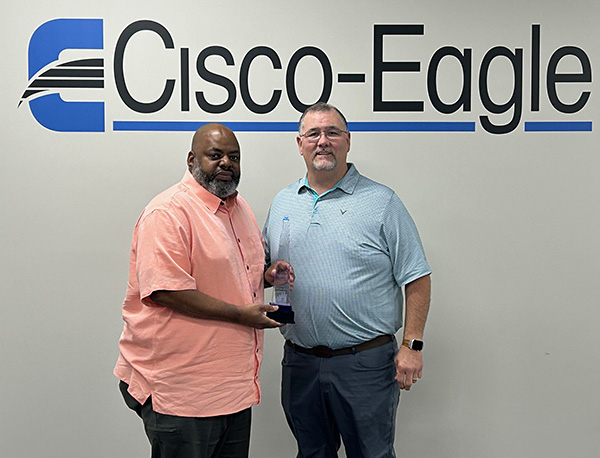
Pflow Regional manager presents award

Left: Pflow Regional Manager Chuck Cobb .
Right: Cisco-Eagle Houston Market Manager Jason Eitreim

Pflow Industries (pronounced “flow”, by the way) recently recognized Cisco-Eagle as a top distributor of its vertical reciprocating conveyor and other lift products. Pflow Southeast Regional Manager Chuck Cobb presented the awards to our President, Steve Strifler, and to Houston Market Manager Jason Eitreim. (more…)

Economic stimulus makes this a good time to implement facility upgrades

February 20th, 2008
by Scott Stone

tax incentives for businessThe big news out of Washington the last couple of months has been on the tax rebate part of economic stimulus. What may have more impact on the economy, and will certainly have more impact on people in the warehousing or manufacturing business, are the business tax breaks that quietly came along with it. We’ll break them down into two primary areas…

(more…)

Cross Docking: What are the facility layout considerations?

January 25th, 2008
by Chris Doyle

This is the third in a series of articles on cross docking

Cross dock facility rendering

If you started from scratch, many might simply build a cross dock facility with a much shallower depth than most warehouses. A depth of a hundred feet or so, with incoming product on one side that can be easily moved a short distance and loaded on the other side to an outbound truck. Most of us however, must deal with an existing facility, many times a large square box which is not generally the preferred layout. However, as long as the existing facility has a sufficient quantity of dock doors, yard space, and an adequate footprint, you may be fine…

(more…)


This article is part of a series of articles on Cross Docking. Click on a link below to view one of the other articles.
  1. Cross Docking: Is it right for me?
  2. Am I wasting time: is cross-docking a viable consideration for my company?
  3. Cross Docking: What are the facility layout considerations?
  4. Cross Docking: A retailer improves supply chain

Getting lean (but not mean) in your warehouse operation

December 30th, 2007
by Scott Stone

cover for lean warehousing book

Sure, we’ve heard all the talk of lean manufacturing, but what about lean warehousing? I’ve been in facilities that have straightened production lines in pursuit of lean principles, and those lines included storage factors and materials handling, but I’ve never seen it specifically done in a distribution operation. Many warehousing operations have probably applied aspects of lean in the warehousing process, but how many have, from top to bottom, implemented a lean warehousing program?

The original concept of lean was designed for mass production of identical or similar items, so a straight conversion to warehousing, where volumes aren’t massive or standardized, isn’t a given. You can’t apply the science of lean exactly the same way, but you can definitely apply it.

(more…)

Am I wasting time: is cross-docking a viable consideration for my company?

December 19th, 2007
by Chris Doyle

cross docking conveyor system

This article is the second in a series of articles on cross docking

In concept and on paper cross docking looks great, but, what about actual implementation? What kind of return do we get on this investment? The short answer is the implementation can be challenging. However, with planning, a committed team of upstream and downstream participants, and possibly even a pilot program, it can pay significant benefits.

Cross docking does not have to be complicated. Some, even today, execute cross-docking using human-readable paper documentation as the driver. As mentioned in the original brief, cross docking can cover a wide range of distribution activities. In one door and directly out the other is one approach. Many cross dockers also add value in the brief (hopefully) interval between receiving and shipping. Others send product to a temporary buffer in the interval, in many of these cases an automated system (mini-load, AS/RS, etc.) serves as the buffer.

(more…)


This article is part of a series of articles on Cross Docking. Click on a link below to view one of the other articles.
  1. Cross Docking: Is it right for me?
  2. Am I wasting time: is cross-docking a viable consideration for my company?
  3. Cross Docking: What are the facility layout considerations?
  4. Cross Docking: A retailer improves supply chain

Cross Docking: Is it right for me?

December 5th, 2007
by Chris Doyle

This article is the first in a series of articles on the subject of cross docking.

Basic cross docking illustrationJudging by the number of inquiries we receive relative to inventory management in distribution, a look at cross docking practices seems to make sense. This will be the first of a series of briefs on cross docking, how and where it works, and a look at some best practice ideas that might be useful to those of you in the distribution business (of all sizes). I’ll also be providing you links to some excellent online references for more information.

Most everyone is familiar with how those like Wal-Mart took the cross docking model, and essentially redefined supply chain efficiency. The results achieved are well-documented. For those of us involved with mid-size organizations, a compelling case can be made for considering cross dock principles in our distribution centers. If you are able to move material from receiving dock to shipping dock, and bypass storage, consider what you gain. Costs associated with holding inventory, protecting it, insuring it, picking it, counting it, and so forth.

Although the “cross docking” term is well ingrained in our supply chain lingo, it is important to understand the concept also applies elsewhere in our distribution centers (more on that later), notwithstanding what you call it. Let’s begin.

(more…)


This article is part of a series of articles on Cross Docking. Click on a link below to view one of the other articles.
  1. Cross Docking: Is it right for me?
  2. Am I wasting time: is cross-docking a viable consideration for my company?
  3. Cross Docking: What are the facility layout considerations?
  4. Cross Docking: A retailer improves supply chain

Recently uploaded conveyor videos for your viewing pleasure

December 3rd, 2007
by Scott Stone

We’ve been busy adding video in various areas of the website, focusing first on conveyors.

There have been quite a few added in recent days. It’s all embedded in web pages (no media player needed!) so it’s easy to view and not worry about having the right player. The videos tend to be the first thing you’ll see when the page loads. Just click ‘em and they play at your convenience.

In no particular order, here they are:

There will be lots more added in the next few weeks. Also, we have added case study videos heavy on conveyor. That includes Excel Beef and ATC Logistics at the moment. More of these coming as available.

To watch, just click the video screen that loads on each page. You can pause by clicking again.

Educational and training opportunities for warehousing and distribution professionals…

November 19th, 2007
by Scott Stone

WERC (the Warehousing Education and Research Council) does some great work.The group offers a terrific online research library with tons of links to web pages and PDF’s on everything from case studies to equipment analysis to facilities issues, people, processes, metrics and tons more. Another excellent resource is always WERC’s annual conference (May 2009 in Chicago) as well as local conferences like the ones we have attended in Dallas the last couple of years. The national event has Stephen Covey, author of The Speed of Trust this year.

Its self-study guides are good, and inexpensive at $14.95 for members and just $29 for nonmembers, with detailed information on personnel, processes, and more.

(more…)