Over the past four decades, we’ve seen plenty of operations move. We’ve installed entirely new conveyor systems into functioning operations without disturbing the flow of existing work. We’ve seen companies pick up an entire distribution operation and move it across two hundred feet of parking lot into another building. It’s not new territory for us, and probably if you have managed a manufacturing or warehousing operation long, it’s not for you either.
Like moving your personal household, it’s chaotic, fast-paced, inconvenient and usually painful – in fact more painful than a personal move because there are so many moving parts, so many ways to get it wrong. How can you reduce the pain and get back into gear as fast as possible?
President Obama’s recent State of the Union address focused on manufacturing in the United States – which everyone, no matter their political persuasion, can agree is a vital part of our economy. Countries that don’t make things aren’t world powers, period.
And the numbers, on the surface, can look dire. According to Forbes, 22 million manufacturing jobs were lost globally between 1995 and 2002. The U.S. has lost hundreds of thousands of manufacturing jobs in that timeframe.
The common belief is that these jobs were palletized and shipped east to China or south to Mexico. That has happened (we’ve seen it in our client base more than once) but it’s only part of the truth. The reality is more complicated, and may help us to understand why manufacturing output has increased in the U.S. even while jobs have been reduced. Manufacturing output didn’t just grow; it rocketed 30% since 1995. China – the supposed vampire of manufacturing employment – lost a whopping 16 million jobs in the sector.
In a word, the “culprit” (if you want to call it that) is automation. Robotics has become less expensive and significantly more capable – and continues to improve.
Sortation systems in distribution is application driven – typically we are talking about order fulfillment (retail, wave pre-sorting, inbound putaway sorts), shipping (end of line carrier sortation, ship to stores), and returns. Traditional sweep sorters, cross-belt, narrow slat & shoe, or belt sorters are often thought of as “for the big guys” in large operations. SpanTech’s new TranSorter is different, and it’s rolling out at Modex 2012. A sneak peek video below:
The TranSorter is built for hard to sort items, such as fragile items that require different handling. It’s good for ultra-lightweight items, poly bags, etc. It’s scalable, flexible, and affordable due to truly modular design, a world of layout possibilities, and competitive pricing. It can also deploy quickly, with 6-8 week delivery times and a couple days installation time. If you’re planning to attend Modex, check it out.
If you are in the warehousing or material handling industry, you’ll find yourself identifying warehouse and handling equipment in movies or television shows quite often. Many of us have seen, for instance, the NFL graphics of a large distribution system used on Fox network for years. I’ve pointed out Hytrol conveyors in movies to my wife for years, to the point where she says it first when she sees it.
For fun, we have put together a list of the more famous scenes in entertainment history involving material handling equipment, and how it could have been done better.
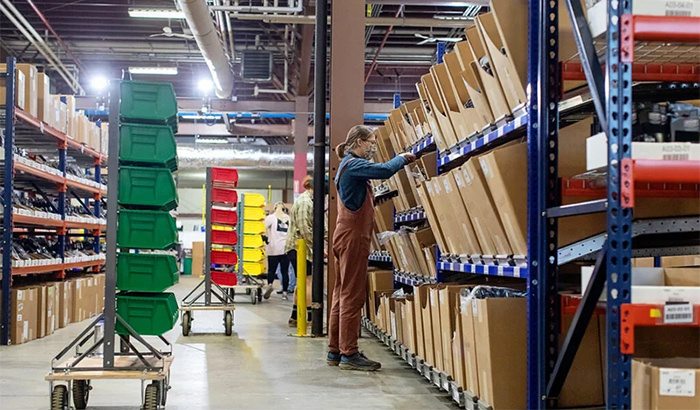
In a pick-to-tote operation, you have the advantage of a dedicated packing function. Since totes can be “one size (or a range of them) fits all”, your pickers can easily pick and organize totes as they navigate the system, either on conveyor or in carts. They aren’t thinking of anything but getting the pick right. Trained packers at the end of the line cartonize the orders, often using state of the art packing stations and consolidated equipment & materials. This means that you’ll have at least two employees (the picker(s) and the packer) touching each order, and that the packing group will need more square footage. What if you decided to pick directly to cartons, eliminating the totes and reducing or eliminating the packing group?
In the not-too-distant past, most companies that weren’t running immense distribution operations, who didn’t have multiple facilities, who didn’t run 24-hour shifts, didn’t even consider automation. Too expensive, they’d say. Too much risk. Too little upside if things go wrong. All valid in context, if we were in 1998. But the reality is this: While most costs—personnel, land, energy— have increased, automation costs have remained steady or declined across the board. The reality today is that the four guys stacking pallets at the end of a line, even for a single shift, even at low wages, are more expensive than a well configured palletizing system.
Those costs aren’t going to do anything but escalate, either. Listed are ten ways automation has become more relevant, even to mid-size operations:
In this operation, differently-sized beer cases are conveyed to the robot to fulfill a specific order. Since the cases vary by width, length, and height, their dimensional information is sent to the robot by the WMS (warehouse management system). The robot utilizes mixed-load palletizing software to determine the best pattern to build a pallet with the available products, achieving high density and stack stability with rapid speed.
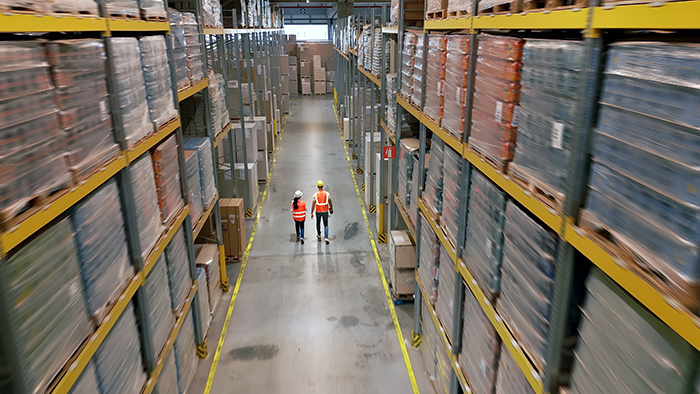
The easiest space to recoup in most every operation is overhead space – the vertical cube. Expanding out costs more than expanding up. Over time, that means utilizing mezzanines, suspended overhead conveyors, pick modules, taller rack systems, the space over dock doors, etc. That space is available in most every warehouse or manufacturing facility, but utilizing it means that you have to be able to move material between levels without creating bottlenecks.
Cisco-Eagle has always provided integrated material handling systems, but we’re entering a new phase by partnering with companies like SSI Schaefer, HighJump WMS, Orion Packaging, Fanuc Robotics, ABB Robotics, von Gal, and more. We recently invited Dr. Sam Chen to join us as Senior Robotics and Software Engineer. Dr. Chen will complement our existing controls and implementation services, allowing us to integrate robotics, palletizers, packaging machinery, and other equipment with conveyors and other material handling solutions.
We have engineered and implemented hundreds of systems in distribution, manufacturing, order fulfillment, and other applications. We can now help clients to a greater degree by providing advanced control systems, robotics, and more.
More details on these partnerships are coming soon.