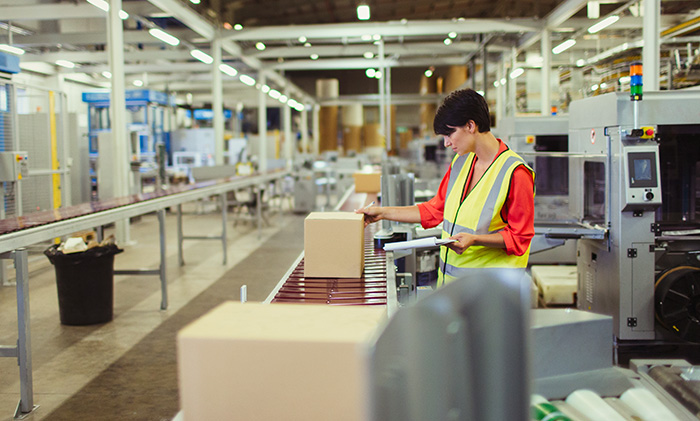
Sortation systems in distribution is application driven – typically we are talking about order fulfillment (retail, wave pre-sorting, inbound putaway sorts), shipping (end of line carrier sortation, ship to stores), and returns. Traditional sweep sorters, cross-belt, narrow slat & shoe, or belt sorters are often thought of as “for the big guys” in large operations. SpanTech’s new TranSorter is different, and it’s rolling out at Modex 2012. A sneak peek video below:
The TranSorter is built for hard to sort items, such as fragile items that require different handling. It’s good for ultra-lightweight items, poly bags, etc. It’s scalable, flexible, and affordable due to truly modular design, a world of layout possibilities, and competitive pricing. It can also deploy quickly, with 6-8 week delivery times and a couple days installation time. If you’re planning to attend Modex, check it out.
Any operation with dock doors faces an uphill challenge when it comes to preserving the climate inside. In particular, air-conditioned and heated facilities must face the reality of losing large volumes of treated air when trailers must be loaded or unloaded. Managers will be asked to scrutinize every expense, and the loss of climate controlled air can be a significant expense.
Retail distribution facilities have multiple options for shipping product to store locations. They can send full pallets which must be unwrapped, unloaded, and stocked at the store location. They can send packed carts that can easily be rolled onto store floors and stocked at the point of sale. What method works best? Read the rest of this entry »
Cisco-Eagle has partnered with Seegrid to offer automated, unmanned industrial pallet and tow trucks as part of our continuing focus on automated storage systems.
We’ve recently posted a guide to stretchwrap machine specification and justification. For operations with the kind of throughput where automation makes sense, machine driven stretchwrappers can enhance quality as well as increase speed. They also offer ergonomic benefits and material savings.
With the advent of widespread e-commerce fulfillment, just-in-time principles, lean management, supply chain collaboration, globalization, the need for ever-faster response, and constant pressure to reduce expenses through headcount and shift reductions, today’s warehouse manager is being asked to do more than ever before.
Cisco-Eagle CEO Steven W. Strifler discusses ways to do more with less in a struggling economy
Achieving more with less is a core goal of most businesses. In the warehousing and industrial world, that means building more, shipping more, doing more – controlling more – with fewer resources. The typical issue is labor in many of these operations. It takes people to run a shipping operation, and plenty of them.
“In economically challenging times like now, you’re being asked to produce more per person than ever,” said Cisco-Eagle’s CEO, Steven W. Strifler. “You’ve probably had to let people go. You may have shut down some areas, cancel contracts, cut a shift, and take the steps necessary to emerge from this downturn. But the big question is, how do you emerge stronger?”
Operations & Fulfillment (an excellent publication you should be reading if you aren’t already) has published a list of the top locations for warehouses and DC’s in 2009, in this article “Where to Warehouse: The Top 10 for 2009.”
The winner this year was Henderson, Kentucky, assuming a single warehouse. Dallas, Texas finished among the best locations in a 5-warehouse network.
Sortation Conveyors divert a product from one conveyor line to another. By using controls and multiple sortation conveyors, product can be sorted by diverting the product only to the appropriate conveyor. From basic pushers to sophisticated cross-belt sorters, distribution centers and warehousing operators have more options today than ever when it comes to automated product sortation.
Warehousing is tough. Manufacturing is tough. Order fulfillment is tougher; the longer the operation runs the more difficult it can get.
You deal with constant disruptions , and the system you carefully designed a few years ago may not be working as well today, after changes in your business climate, personnel changes, SKU alterations, new lines, changing storage requirements, corporate policy changes, or issues with key suppliers or customers. These things happen, and at some point, all or most of them will occur in every operation. If a series of small changes have added up to big headaches, what can you do?