Sortation systems in distribution is application driven – typically we are talking about order fulfillment (retail, wave pre-sorting, inbound putaway sorts), shipping (end of line carrier sortation, ship to stores), and returns. Traditional sweep sorters, cross-belt, narrow slat & shoe, or belt sorters are often thought of as “for the big guys” in large operations. SpanTech’s new TranSorter is different, and it’s rolling out at Modex 2012. A sneak peek video below:
The TranSorter is built for hard to sort items, such as fragile items that require different handling. It’s good for ultra-lightweight items, poly bags, etc. It’s scalable, flexible, and affordable due to truly modular design, a world of layout possibilities, and competitive pricing. It can also deploy quickly, with 6-8 week delivery times and a couple days installation time. If you’re planning to attend Modex, check it out.
Conveyors are exceptional in their productivity enhancement for manufacturing and distribution operations, but they need attention – and not just from your maintenance group. Everyone involved with them should be aware of the safety and performance issues involved. Here are five practices for happy conveying…
Conveyors, like any capital investment have multiple costs. The amount on your invoice is hardly the last time you’ll pay for that conveyor. If a conveyor is correctly specified and designed for future use, significant cost savings can be realized.
The three costs:
Initial costs – the easiest to understand and quantify. This is the cost of equipment, installation, and controls.
All of these costs are spread over the conveyor’s useful life, so a formula that might best express what your conveyor will cost is: TCO (total cost of ownership) = IC (initial cost) + OC (operational costs) + MC (maintenance costs)/ useful life of the system.
Higher initial costs may be recouped in lower maintenance and operational costs over time if the right decisions are made when the equipment is specified and ordered. The initial cost savings can be eaten up by higher operating and maintenance costs, but neither of those is as expensive as a system that cannot do the job it was deployed to do. Long term costs can easily outstrip the initial costs. What are the real, long term costs and what can you do to control them?
As part of our goal to provide you with more information and tools about the products we offer, we have added four new online conveyor calculators to the website. These calculators will help you to find the right conveyor for the job.
Let’s take a look at each calculator, and what they can do for you.
Incline Calculator. This calculator will provide you with dimensions for an incline conveyor. You can answer questions such as “Will an incline conveyor fit in the space I have?”, or “Given a specific angle of incline, how long will the conveyor need to be?” With incline conveyors there are four basic dimensions and the incline angle to consider. If you know three of the dimensions or the angle, the calculator will provide the missing dimensions or angle.
Box Tumbling Calculator. The taller the carton, container, or box you wish to move on an incline, the more prone it is to tumble. If you enter the dimensions of the product, the calculator will provide the maximum angle of incline before it will tumble back down the conveyor.
Skewed Roller Calculator. If you need to align a package to the right or left side of the conveyor one method is to skew the rollers by moving one end of the rollers over by one notch in the frame. This calculator will tell you the length the package will need to travel across skewed rollers to move the package the required distance to one side.
Minimum Curve Width Calculator. As a package is being conveyed through a curve it can become jammed between guardrails if the curve is not wide enough. This calculator will help you find the minimum width required to move that package through the curve without jamming.
There is still more to consider in the proper design of conveyor, and these calculators address some of the issues. Contact us if you need more assistance with a complete design for your requirement.
Sortation Conveyors divert a product from one conveyor line to another. By using controls and multiple sortation conveyors, product can be sorted by diverting the product only to the appropriate conveyor. From basic pushers to sophisticated cross-belt sorters, distribution centers and warehousing operators have more options today than ever when it comes to automated product sortation.
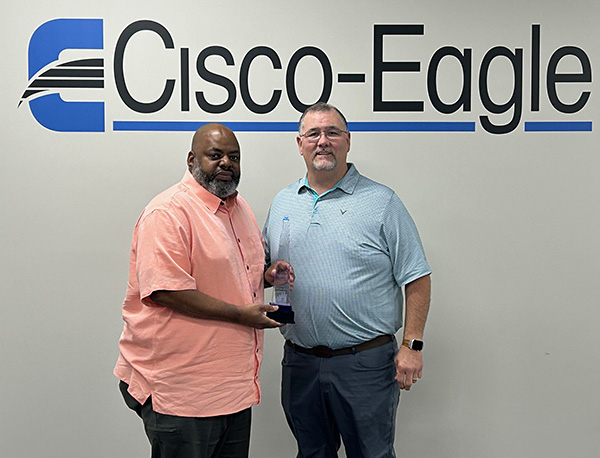
Above: Hytrol’s Bill Hawthorne presents Cisco-Eagle President Steve Strifler
with a plaque honoring our 2007 conveyor sales achievements
Cisco-Eagle and Hytrol Conveyor Company recently celebrated our partnership at CEI’s Dallas, Texas facility. Hytrol CEO Greg Goodner, Bill Hawthorne, Matt Farris, and Frank Nichols came to Dallas to present a plaque honoring Cisco-Eagle’s placement as one of the company’s top conveyor distribution partners in 2007. Cisco-Eagle typically finishes among Hytrol’s top 3 distributor/integrators, and recently passed $100 million in total purchases from Hytrol.
Since the gathering was a day before Goodner’s birthday, we honored him with a cake and happy birthday serenade.
This is the third in a series of articles on cross docking
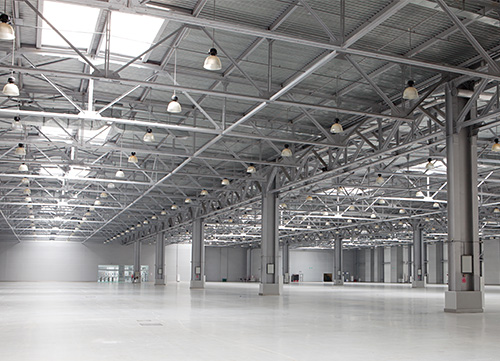
If you started from scratch, many might simply build a cross dock facility with a much shallower depth than most warehouses. A depth of a hundred feet or so, with incoming product on one side that can be easily moved a short distance and loaded on the other side to an outbound truck. Most of us however, must deal with an existing facility, many times a large square box which is not generally the preferred layout. However, as long as the existing facility has a sufficient quantity of dock doors, yard space, and an adequate footprint, you may be fine…