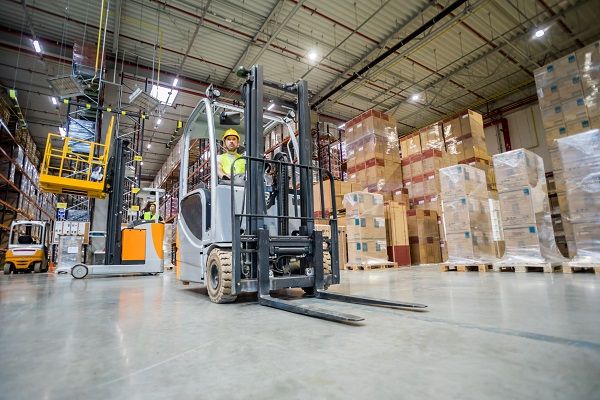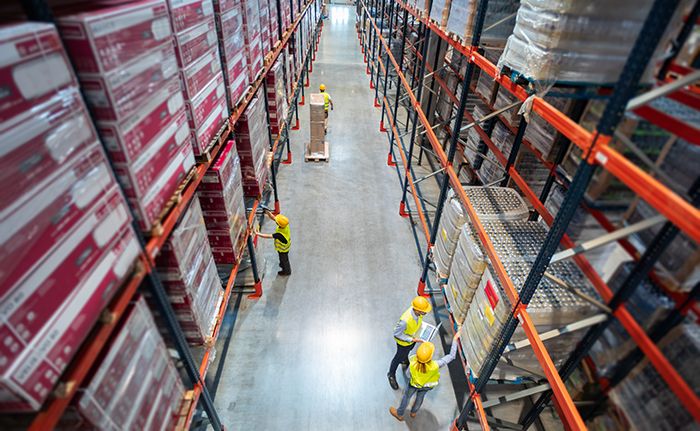


Forklift aisle widths are typically set when pallet racking is installed. In many cases, such as narrow aisle projects, these spaces are critically important. Typically, warehouse managers don’t attempt to lay out these types of storage facilities. But for reach truck, selective rack applications, these aisle sizes are often “eye balled”, or given a 12′ width no matter what type of forklift is using the aisles. If you are laying out a facility, what criteria should you use for rack aisle width?
Can you cause a pallet rack collapse with a simple kick or push? In this video, it seems you can. But what really happened to cause such a dangerous incident?
The kick itself, while inadvisable, should not cause a pallet rack collapse. Some conjecture on the real cause of this near-fatal incident:
In any order picking, assembly, packing, or palletizing process, time spent walking is wasted. Value is realized at work areas, not in transit between them. In many operations, order pickers can walk as many as 12 miles a day. This level of walking makes workers tired and more prone to error, injuries, and declines in productivity. While some degree of walking is unavoidable, much of this is simply commuting time to retrieve supplies, or inefficient design that makes the job harder and less efficient than it should be.
How can you reduce time walking, and increase the time people spend getting things done?
Whether you’re operating a dedicated distribution center or the order fulfillment or stock warehouse of a manufacturing operation, most industrial facilities deal with storage and warehousing to some degree. In the not-so-distant past, warehousing was treated mostly as a cost center – a necessary evil that had to exist so that the more profitable parts of an enterprise could operate. Thankfully, more enlightened thought has prevailed recently.
Order fulfillment and storage are not just places you can save money – they can earn money. If the gremlins don’t get you.
Pallet rack is typically safe and easily-maintained storage equipment, whether you are dealing with selective, pushback, drive-in, or other types of rack. But if you load it wrong, if you don’t inspect and repair/replace damaged components, if you don’t understand your capacities, and if you don’t take steps to ensure your rack isn’t impacted by loading equipment, that safe rack can become dangerous and expensive.
We have created an infographic to help you navigate the most common mistakes people make dealing with pallet racks. Feel free to share this graphic to any site or other media. It is the first of many infographic posters we’ll be offering to help people operate and maintain material handling equipment.
Increase customer satisfaction. Moris explains that right-sizing your packages can reduce carton size and ensure customers receive the right package at the right time.
Reduce packaging costs. By using cartonization strategies, you can reduce parcel sizes – and by extension, shipping and packaging costs.
Decrease labor and increase throughput. By optimizing its sortation systems, one retailer cut 62 cents off every package shipped.
Reduce freight, sortation, and shipping costs. Reducing carton dimensions does all of these things in a world where just a single sheet of paper is capable of changing a carton’s shipping class.
We live in a world where weight and dimensional measurement of packages is becoming faster and easier to gauge. Shippers can and will be able to charge more for smaller and smaller differences, so every bit of the process you can automate and optimize, the better. There are more tips (and plenty more detail) at the article – check it out.
In many operations, things like conveyors or pipe runs or other machinery interrupt the flow of a work floor, and the obvious way to get around it is to erect a crossover. This is commonly done in larger scale conveyor systems with longer lines, but we also do them for other areas where going around the obstacle could take significant time, or where access is limited by other factors. The question is, what type of crossover best fits your needs?
According to OSHA, training is the key to forklift safety, and there is fundamental agreement on that. Training can and does make a serious dent in the high injury rates suffered due to industrial traffic. Training must happen, and it must be repeated. But that begs this question: Why has training failed to move the needle when it comes to serious forklift related injuries? The numbers seem to have stabilized at an average of 100 deaths per year, and have stayed consistently at that level for years.
If you’re paying someone to store a pallet for you, what’s reasonable? Are you overpaying for convenience or location? It’s not easy to compare 3PL vs. 3PL, or even your own warehouse so you know for sure if you are getting value for your money. But there are some basic assumptions you can make to help you understand what you’re dealing with, the costs the 3PL may experience, and reasonable costs for your storage projects.
Sheet metal is one of the most difficult handling challenges out there. It’s simultaneously bulky, heavy, somewhat flexible, and prone to damage if handled incorrectly. It often has sharp edges and corners, making it dangerous to manually move and turn. At higher gauges or in bundles, it requires forklifts, cranes or scissor lifts for safe and effective handling. Even a thin sheet, if it’s 4 x 8, can be too much for a single worker to handle.
Yet, sheet metal is commonly used in manufacturing and fabrication, so finding better storage and handling methods is key. What can you do to handle it better?