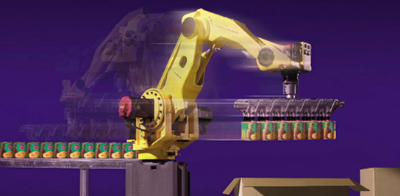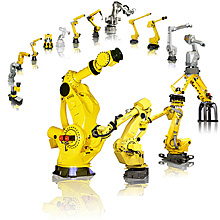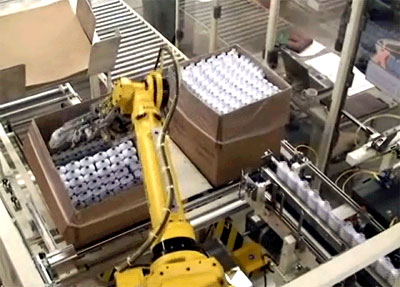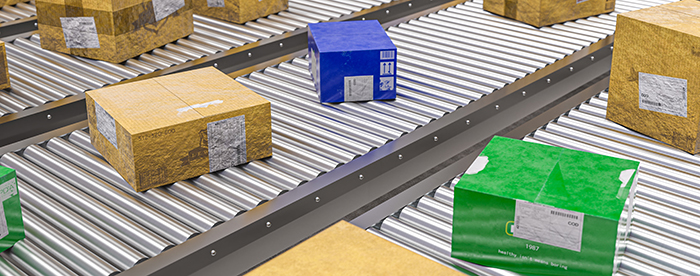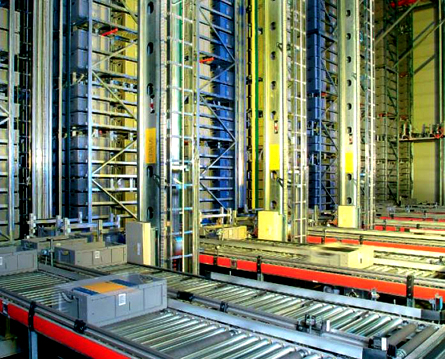
Industrial engineers have envisioned fully automated factories since at least the middle of the 20th century. But the real race to automate manufacturing can be said to have begun in the 1980s, when US car manufacturers came up with the vision of “lights-out” manufacturing. The idea was to beat their rivals by automating the factories to such an extent that the entire manufacturing process could be left to robots. To a great extent, it has remained only a vision so far. Read the rest of this entry »
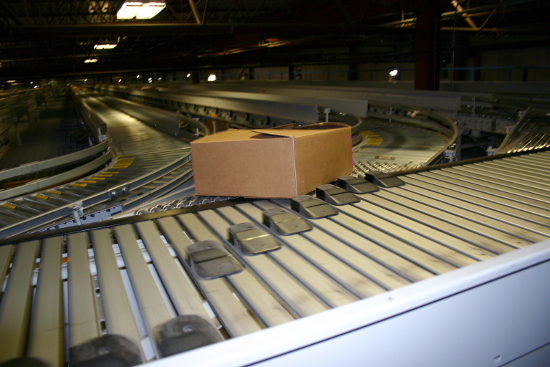
Manufacturing Automation: What Is It? Where Is It Going?
Tags: Automation, Manufacturing, Robotics, Industrial Robots
Posted in Automation, Labor & Efficiency|
Are We Automating Jobs Away?

In the last 200 years 70% of jobs done by American workers have been replaced by automation – and during the next century we will see another automation revolution that replaces 70% of American jobs–again.
Read the rest of this entry »

Tags: Automation, ergonomics, Safety & Ergonomics, Robotics, workers force
Posted in Automation, Labor & Efficiency|
Pick Light vs. Voice-Directed vs. RF Picking Systems
These systems are at their best for open case picking systems. When you’re picking full pallets and cases, they’re less useful, although that depends on the situation. You can mix these systems in a single facility of pick pod area for maximum effect with inventory slotted to match the necessary profile. Each has a role, depending on what you’re picking, how your facility is set up, and the nature of your picking methodology. What might be best for a given situation?
Tags: pick to light, voice directed picking, RF systems
Posted in Automation, Labor & Efficiency|
The Wonder of Robotic Palletizing

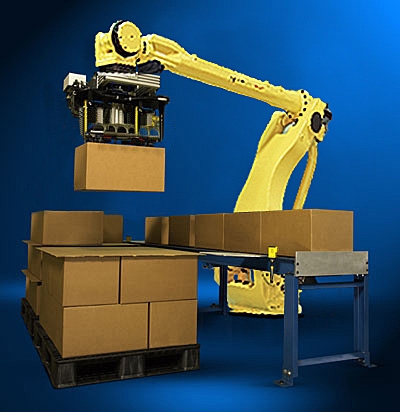
I recently attended an ESOP event at a specialty paints and stains company. During the tour of their plant, I got to see a robotic palletizing system in operation. I was impressed. Standing about 6 to 8 feet away from the action, I watched as it placed 5-gallon cans of paint in rows of 3 stacked 3 high. Each row was offset from the previous one, so that optimum pallet space was used. As the robot picked up cans off the conveyor belt using a vacuum end effector, it placed them precisely on the pallet. Then, it slightly dropped down and “bumped” them to make sure they seated onto the row below. That action made me chuckle as I considered what a profoundly human act that was – a little hip action to make sure the cans seated correctly.
Tags: industrial safety, palletizing, ergonomics, Robotics, Time-savings, lean manufacturing
Posted in Automation, Labor & Efficiency|
WCS vs. WMS: Complementary Warehouse Software
A warehouse control system (WCS) directs “real-time” activities within warehouses and distribution centers. They act as a traffic regulator for warehousing activities, with the mission of running material handling systems (and in some instances, the activities of workers). A good WCS system provides a broad, yet consistent interface for material handling systems like conveyors, carousels, palletizers, sorters, etc. On the other hand, a warehouse management system (WMS) is more focused on broader activities, people, and processes, such as shipments and orders. WMS usually doesn’t reach downstream into the automated equipment itself. A WMS is more about controlling human interactions to fulfill or receive product.
Tags: WMS, Automation, software, wcs, warehouse control
Posted in Automation, Labor & Efficiency|
Spreadsheets vs. Software for Product Slotting

Product slotting is something that you must do as your inventory profile, customer requirements, and other factors evolve. Sometimes, it’s a simple job; people have been known to do it in their heads. Others utilize spreadsheets of various complexity. Beyond that, you can get into dedicated slotting software, consultants, or comprehensive WMS/WCS.
What are the considerations when it comes to deciding what method you’ll use to slot your warehouse or forward picking area?
Posted in Automation, Labor & Efficiency|
Industrial Automation and The Flexibility Problem
Earlier this year, Food Logistics published a provocative article, “Automate or Die”.  Do you have to automate? Of course not. But it brings to mind a good question: where is the point of acceptable ROI for automation projects? When does it make sense? What aspects are potential pitfalls?
We’re  inside warehouses, distribution centers, commercial operations, and manufacturing facilities every day. We don’t see full scale automation in all — or even most — of these operations. We’ve even seen some companies who have automated go back to picking with carts. We’ve seen others thrive due to their automated projects. The point is, you certainly won’t “die” if you don’t automate. But that doesn’t mean that you should not automate some or all aspects of your operation.
In some cases, we try to make the case that automation isn’t needed. In others, we try to help these companies understand when a capital investment in automation equipment and/or software will save money, increase productivity, reduce problems, and improve their business. It’s not  something that you can do from a distance.  It requires a command of the facts on the ground, in the servers, and throughout the supply chain.
So, the question is, why automate?Â
Tags: Robotics, inventory, Warehousing, labor, ROI
Posted in Automation, Labor & Efficiency|
Vertical Lift Modules vs. Horizontal Carousels

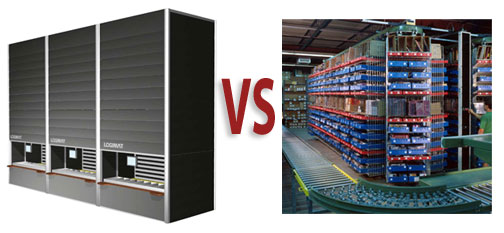
When you are considering an automated picking solution, you have lots of choices. One of the more frequent comparisons is between horizontal carousels and VLM’s – vertical lift modules. Both promise similar efficiency gains: they bring products to pickers rather forcing pickers to move to picking stations in shelving or racks. But which is best? That depends on what set of criteria you use, and what’s important to you.
Tags: warehouse technology, Automation, picking systems
Posted in Automation, Labor & Efficiency|
Robotics and End of the Line Packaging

The end of a manufacturing or distribution line is where the rubber meets the road for many operations. It’s potentially the last place where you have direct control of your product before it ships to retailers or direct customers. It’s where you can add a lot of value…or spoil a lot of value. The end of the line in many ways is more important to your company’s image as all its public relations, its websites, its brochures. It is often where your reputation can be made.
Tags: palletizing, Robotics, Packaging, Conveyor, Automation
Posted in Automation, Labor & Efficiency|
Ten Reasons to Automate Your Operation

In the not-too-distant past, most companies that weren’t running immense distribution operations, who didn’t have multiple facilities, who didn’t run 24-hour shifts, didn’t even consider automation. Too expensive, they’d say. Too much risk. Too little upside if things go wrong. All valid in context, if it was 1998. But the reality is this: While most costs—personnel, land, energy— have increased, automation costs have remained steady or declined across the board. The reality today is that the four guys stacking pallets at the end of a line, even for a single shift, even at low wages, are more expensive than a well configured palletizing system.
Those costs aren’t going to do anything but escalate, either. Listed are ten ways automation has become more relevant, even to mid-size operations:
Read the rest of this entry »

Tags: warehouse technology, Factory Automation, ergonomics, Cost Reduction
Posted in Automation, Labor & Efficiency|